Monday, June 27, 2011

The Unauthorized Autobiography of Captain Polyglot


I am an expert at all things that are not Korean. You may not believe this. And I may not believe this. But all the Korean employees at my workplace unequivocally believe this. They believe it the same way 4-year-olds believe in Santa Claus. And with utter confidence in my far-reaching knowledge of all things not Korean, they ask me for information regarding words in French, German, Portuguese, etc.

Sadly, though, I am not what you'd call a "language person." It's true that while in university, I took one year of accelerated classes in Italian and was always at the top of my class, but in spite of my almost-adequate grasp of Italian while in uni, my knowledge of it has receded in the years since so that now the only thing I feel confident about in Italian is how to order an ice cream. Really, this is the most important phrase anyone can use in Italy, anyway, so that's all good. But to return to the shores of my now-distant main point, my knowledge of ordering ice cream has become the basis for my understanding of all Romantic languages, so that I feel sufficiently informed to take a stab at defining pretty much any foreign word that my coworkers present to me.

Also, I cheat and use the Internet.

"Oh yes, ajdiwureojaksldfj, yes, of course I'm familiar with it. I'm just a little busy now. Give me a minute and {Google, Google, Google, Wiki, Wiki}, yes, it means 'the velvet canvas on which religious icons are painted by Polish farmhands.' And it's pronounced *imitates cat unsuccessfully trying to rid itself of a hairball*."

As you might imagine, this system works very well for me. By which I mean, I still have a job.

Sometimes, though, my coworkers will hand me a paper with a word that's -- not to be judgmental or anything -- totally weird.

I take the piece of paper and squint at it. Pretend astigmatism makes an excellent stall for time.

"That's not an English word. No, it's sure not," I'll observe as I stare at a word in Yiddish? Russian? Something-stan?

"Errm, it's not even written in the Roman alphabet," I'll then point out, in what I intend as a mild protest.

"Yes, that's true," my coworkers will respond, smiling. "And how do you pronounce it?"

The result of which is that one of our language CDs may or may not have a speaker mentioning farflugen where a Yiddish-Russian-Something-stan word would actually be more appropriate. Because farflugen is the most exotic-sounding word I know. I think the Swedish chef from The Muppets used to say it, so I guess that makes farflugen Swedish. Who says you can't learn by watching prodigious quantities of TV?

Sometimes, to be perfectly frank, I feel I'm not the best person for this job. However, I seem to be the company favourite, as out of the three native English speakers in my office, I am decidedly the one most often chosen to answer questions about all things not Korean.

I once overheard a conversation between a Korean coworker and one of the other native English speakers, Evil Disney Princess (a moniker bestowed for her unique ability to say the meanest things imaginable in a voice sweet as honey), about a certain English word. I didn't hear the whole convo, but distinctly heard EDP advise that "The dictionary is wrong about that word."

Perhaps that is why I've been designated as Captain Polyglot. I never tilt at Oxford or Webster. And as for Roget, I feel absolute adulation, affection, devotion, emotion, passion, rapture, relish, and respect.

Anyway, I was just kidding about that farflugen stuff. But if you ever hear the word "onomatopoeia" seemingly used out of context on an EFL CD. Well, that one just might be me.

Friday, June 17, 2011

Train to Nowhere, Japan


"I want to go to a small town," I say vaguely. "One that has nice cherry blossoms."

"Where?" the woman at the tourist help desk in Nara asks.

"Where do you like to see the cherry blossoms?" I counter.

She pauses thoughtfully for a moment and then uses her pen to scratch out a name on a scrap of paper. Immediately afterward, I walk to the train station to buy a ticket there. Even though the train stations in Japan are uniformly Neat and Orderly, I still have trouble figuring out which ticket to buy, so I press my finger against the round, red "help" button at the bottom of the automated ticket machine. Instead of a help screen appearing on the machine, as I'd anticipated, a square in the wall next to it snaps open, revealing a sort of camouflaged window I'd not noticed when it was closed, and a Neat and Orderly ticket agent pops his head out the window.

"May I help you?" he asks. It's an Alice in Wonderland moment.

I show the man my scrap of paper and he guides me through the correct series of buttons to push on the machine.

{decorative tiles on traditional Japanese roof}

My destination, whose name I remember as Yashimoto though I can find no evidence of its existence from the Internet or guidebooks, is a tiny town where any visitor can attain insta-celebrity status by virtue of blonde hair! blue eyes! As I slowly walk through the town, a few people come up to me to shake my hand. A few others greet me with, "Hello-welcome-how-are-you?" and then quickly dash away before I can form a reply.

The center of all activity in town seems to revolve around an old castle that is surrounded by a moat and located on a hill. Before reaching the castle itself, I happen upon a nearby temple. On the outside porch of the temple are numerous plexiglass tanks containing small, brightly-coloured fish. This is so curious of a matter, unlike anything I've seen in other temples in Asia, that without thinking I ask the man nearest me, "Why are all those fish at the temple?"

{temple fish}

The man stares at me in concern. I repeat the question slowly, point at the fish in question, smile and shrug. The first man calls over a second man and relays my question to him. The second man deals with me by passing me along to a group of teenage boys who are shyly reluctant to make my acquaintance. After what appears to be a polite debate among all the men of Yashimoto, one of teenagers makes a phone call for an outside opinion about the fish. After about 15 minutes of this, they settle on a conclusion. One of the young men, urged forward by the rest, solemnly makes the pronouncement: "Fish. Good. "

{sidewalk fish tile}

Relieved that the temple fish are not of a malicious nature, I thank the gathered assembly of boys and men (and I honestly am grateful for the amount of effort they'd put into answering my question). We all respectfully bobble up and down, and I continue on my way to the castle.

Lining the stony path to the castle is a row of rosily-striped vendor tents. I stop by one that has a small group of very happy children collected in front of it. I watch as the vendor mixes a concoction of sugar and syrup and colour in a small iron skillet and then carefully dribbles the mixture onto wax paper, swirling it into Japanese characters. He is making giant lollipops with children's names on them.

{a genuine sugar daddy}

The group of children gathered there stops watching the candy making and begins watching me watching the candy making. One of them giggles and whispers something to his friends. With admirable boldness, he then asks if I have a boyfriend and tells me that I am cute. I really want to tell him no, you are so cute and pinch the darling baby-fat of his round cheeks. But such a response would be a blow to the dignified persona he is working so hard to achieve, so instead I point out that I am old, a grown adult, and ask him why he isn't in school on a weekday. He assures me the age difference won't be a problem since he is "also old, in junior high, almost high school."

This is what I get for hanging out at candy booths.

{my name in Japanese, in candy, possibly upside down}

After buying a container of assorted sushi (and an oversized lollipop with my name spelled out in glossy candy form), I settle on the soft grass under some cherry blossom trees and picnic alongside dozens of Japanese families. The sun's brilliance falls across the lawn, adding a glimmer of warmth to the chilly spring day. A few feet away from me, the ancient castle towers.


Addendum:
The lovely Amanda from http://www.notaballerina.com/
has identified the town I visited as Yamatokoriyama with Koriyama-jo [castle].

Thursday, June 9, 2011

Bow-Wow Soup in Korea or "What's for Dinner?"


Seolmi and I angle our chopsticks into the various dishes spread across the table. We use them like tiny extended hands to pick up long strands of fried noodles, udon-infused squares of fishcake, and pieces of delectably tender sushi. Our conversation drifts in and out of various topics. I take a bite of the sushi and rave about its deliciousness.

"Mmm, this fish tastes great!" I enthuse.

"Have you had dog or cat?" Seolmi asks.

"No, no! Never!" I protest.

In the shadow of its other culinary offerings, Korea has a reputation for serving bosintang or meong meong soup (the latter of which translates to "bow wow" or "woof woof" soup) in a few, select restaurants tucked away in some of Seoul's poorer alleyways.

Images flash through my mind of all the dogs who have reached cult-like status via Western movies and TV: Beethoven, Benji, Toto, centuplicate (+service) Dalmatians, and the most classic canine of them all, Lassie. It didn't matter how many times little Timmy fell down that well (being so very accident-prone as to make viewers wonder whether he harbored latent suicidal tendencies), the border collie Lassie was always there to save him. No one should ever have Lassie for dinner.

"I would never do that!" I proclaim emphatically. "I would never have dog or cat. For me, it would be like eating a baby!"

I pause in the midst of my raving and look more closely at Seolmi. She has a strange expression on her face that I can't quite read, and her mouth hangs open slightly.

Quickly, I switch the nature of my speech. I've been so insensitive. Maybe Seolmi's parents raised her on woof woof soup. Maybe her grandparents had resorted to eating it due to lack of better food options during the war and the tradition carried down a few generations. Who am I to judge another person's culture, especially someone who is trying to be my friend?

"It's okay if you eat dog," I amend apologetically. "We're from different cultures. I understand that."

Then there is silence. A long silence.

Finally, Seolmi speaks.

"Not eating dog or cat," she says. "Having dog or cat. For pet."

Monday, May 30, 2011

Are You Afraid to Travel?

As a child, my shyness and sensitivity were such that Emily Dickinson, that queen of recluses, would have appeared as a raging socialite by comparison. When the phone rang, I would run and hide because if I were near the phone I might be asked to answer it, and if I answered it, there was the chance (oh, horrors!) I would not know the person who was calling. I was almost pathologically shy -- except for when I was with my best friend, Amy. During those times, I would talk too much, laugh too much, and daydream out loud. When I was with my best friend, I acted like the person I would eventually grow up to be.

Amy and I met in kindergarten. I immediately took to her because she wore her hair in princess-like brown braids, sometimes in loops above her shoulders, sometimes pinned above her head. And she was always smiling. I liked that. Amy and I spent nearly every waking moment of our childhoods together, as well as many sleeping ones in what seems, in retrospect, like summer-long slumber parties. As we loped through the awkwardness of adolescence, we had a fight, grew apart, and lost touch. But when I remember Amy, I think of sunshine and fresh-cut grass, picking sweet wild strawberries, dressing in costumes of tulle and glitter, creating worlds of faeries and witches and sophisticated cats who wore top hats and ballgowns, pedaling our bikes so quickly uphill that our legs ached, and racing so fast downhill that it felt like we could fly. She was the other half of my childhood. But Amy didn't make it far beyond childhood herself, dying from cancer at the age of 25.

There have been other friends and acquaintances in my social circle who have died. Though not as close to me, their deaths were sad and unexpected. People who were in their 20s, 30s, and 40s. People who radiated health and happiness. People who had simply gotten in their car at the wrong time, turned down the street just 3 minutes too soon.

Nana, mother to my mother, was the only person on whom I could always depend. Hours after an unexpected heart attack, she spoke her last words to me from a hospital bed. I watched her, the person I loved most in all in the world, as she died. Then there are the other relatives who faded from life -- my aunt and uncle on an icy Christmas Eve, all my other grandparents, a distant teenage cousin. As Elizabeth Bishop wrote, the art of losing isn't hard to master.

When I tell people about my plans to backpack alone around the world, the comment I most often receive is: Aren't you afraid?

Do you want to know the truth?

I am afraid of many things. I'm afraid of not helping others enough, not deferring to God enough, being unable to write a decent story, never finding someone who will love me enough to stick around. I am afraid of simply not being good enough.

And that just covers the internal fears. There are also the more pragmatic fears directly related to travel: the potential of being physically hurt by someone, attacked by an animal, or caught in the path of natural disaster. There are a lot of things that are scary in this world.

Last August, a man tried to break into my apartment in Seoul while I was at home. I was alone in a foreign country and without a working phone at the time. For weeks afterwards, I felt frightened if a man walked too close behind me on the sidewalk. Tears would start in my eyes if a friend ran up and greeted me in surprise. (Some of my Korean friends would then exclaim, “Oh, I’m so sorry. I forgot you were American,” thus starting a strange stereotype that all Americans, in fact, cry when startled.)

I’d walk down nearby streets in the area and study all the men. Was it you? Was it you? Was it you? I’d think. But I didn’t tell anyone the extent of the fear I felt. I even felt guilty for continuing to feel afraid, like I was being a drama queen. After all, the man had not been successful. He hadn’t found a way into my apartment. He hadn’t touched me.

After I moved from that apartment and months passed, I believed myself to have gotten over the scare of that night. But when traveling through India with Katie, the fear of being attacked in my sleep reemerged. Katie would sometimes get up in the middle of the night to use the bathroom. Still asleep, I sensed someone was nearby, moving in my bedroom. Without even opening my eyes, I'd begin to yell things like, "Get out of here! Go away! Leave me alone!" Then, through the haze of my terrorized dream-state, Katie's voice, tiny and frightened, would break through. "It's just me. I need to pee!" she'd softly exclaim. "Sorry," I'd mumble into my pillow and re-immerse in sleep.

In the situation where I’d actually been threatened, I was lucky that the would-be intruder had failed in his several attempts to enter my apartment, that even though he'd pried at my door and opened my windows, there were locks and bars that prevented him from entering. But what if there's a next time? What if I'm not so lucky then? I like to think that God protects me, but the truth is that good people get hurt all the time for reasons I'll never fully understand.

So yes, I'm afraid of traveling alone through the world. The possibility of getting hurt is a valid fear; but I'm still far more afraid of dying before I've fully lived.

I can't believe that we would lie in our graves wondering if we had spent our living days well. I can't believe that we would lie in our graves dreaming of things that we might have been. ~ Dave Matthews Band

Now in Seoul, I'm friends with a dancer who has the words Carpe Diem tattooed in delicate, beautiful curlicues around his wrist. I pursue a friendship with him because of that tattoo and because he goes by the nickname Dreamer.

"We are alike," I have told him several times. "Similar personalities."

I rarely see Dreamer, though, since he spends most days at the office working until late at night, even during weekends. I told him about my plans to take a year off and backpack around the world.

"Oh, that's my dream, too," he replied softly.

"Well, why don't you do it?" I asked.

"I can't," he replied with quiet resignation. "I'm Korean. I need to get married, make a family and a career."

I can't recall any particular negativity I've encountered when telling my friends and family about my plans to travel around the world, except for one fiercely-opinionated woman who flat out told me traveling around the world would be quite impossible unless I were rich.

I smiled at her and nodded.

"Yes, it may be impossible," I said, "but I'm still going to do it."

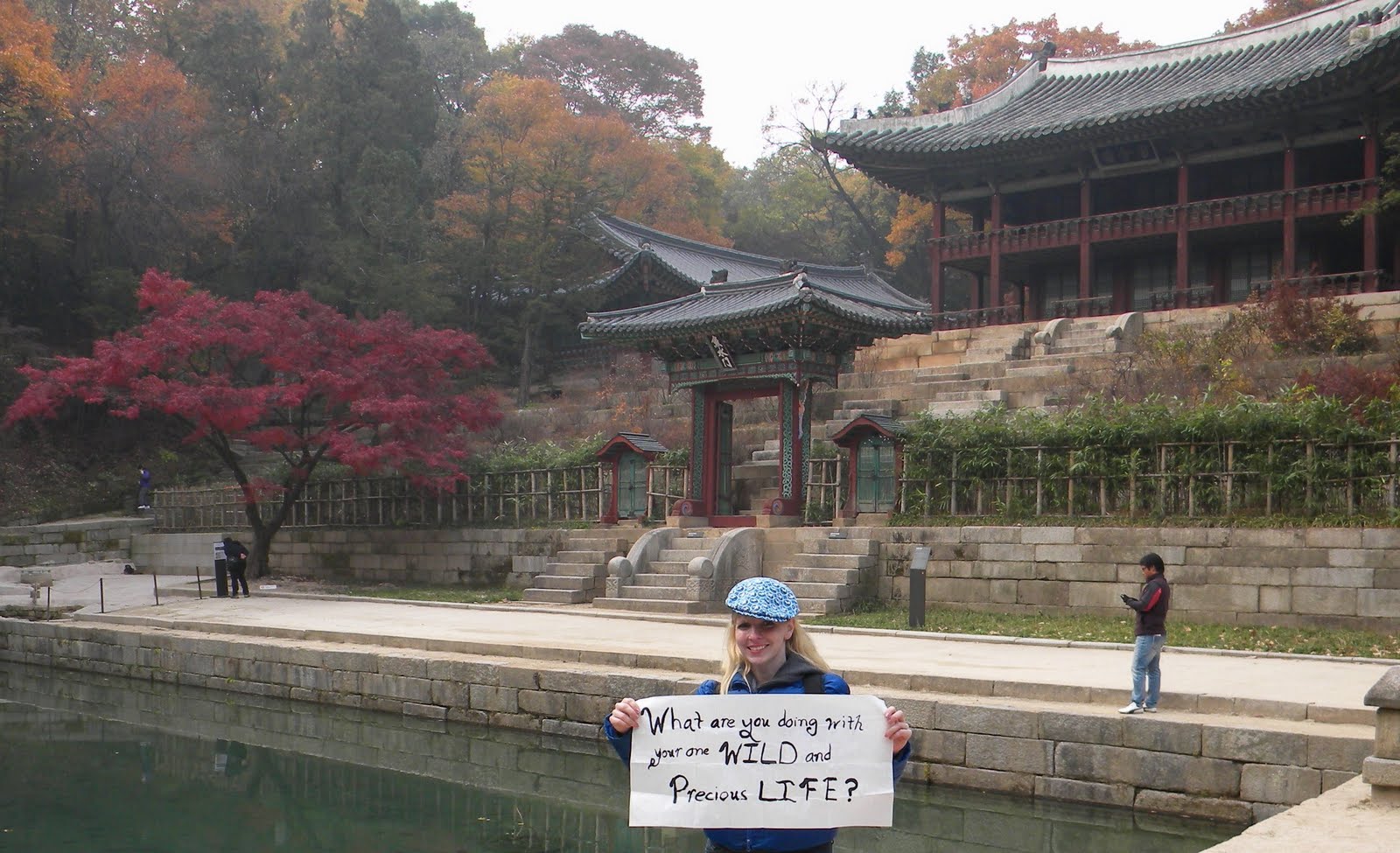
{What are you doing with your one wild and precious life? ~ Mary Oliver}

Friday, May 20, 2011

A Smurfy Sort of Day: Office Life in Korea


A smurf has wandered into our office -- Smurfette herself, to be more specific. "Why?" I keep asking my coworkers, but no one seems to know. This makes today pretty much the same as any other day in Korea, when I also don't understand much of what's going on.

The good part to constantly being perplexed by my surroundings? I've learned to let things go, drift along with the currents that are moving through the city and my daily life. Ignorance is Zen.

Smurfette, who is much larger in the real life than the cartoon ever led me to believe, wanders up and down our office aisles. She carries a long yellow stick with a molded plastic hand attached to the end of it. For a while, she seems content with simply using her stick to poke office workers in the back. Then she rocks back and forth in silent laughter as the more attentive workers, who just seconds previously were focused on the computer screen in front of them, leap from their seats in surprise. Soon enough, though, the whole office is made aware of Smurfette's presence. Without the element of surprise, she begins to grow weary of this game.


Next, Smurfette moves on to the ever-popular Korean pastime of "rock paper scissors." Smurfette uses her real hand (well, comparatively real -- it is blue, fuzzy, and more mobile than her yellow stick hand) to play rock paper scissors. My coworkers who win are given what appear to be delicious pasties but are actually fancy bars of soap molded into pastry replicas. My coworkers who lose are given a pretend slap in the face with the fake yellow hand. I can't look away.

Soon enough, Chun Kyung, the office worker who sits next to me, notices my fascination with the smurf and pulls her over to play with me. I am proud to report that my cunning strategy and flawless execution while competing in rock paper scissors allows me to receive a soap rather a slap.

"Yellow hair! Yellow hair!" all the textbook workers closest to me cry, pointing at the obvious similarity between me and the tall blue creature beside me. Even Smurfette herself seems impressed by this parallel in our appearance. She gently thumps her hand against the top of my head, as though I were some sort of exotic pet belonging to the smurf community.

"You're sisters," Ji Hee smirks.

I still don't know why any of it happened.

Monday, May 16, 2011

Cherry Blossoms in Japan


Although I go to Japan as a solo traveler, I find that I am rarely alone. In Kyoto, especially, I am often approached by Japanese ladies, usually in pairs.

Where are you going? Are you lost? Can I help you?


It is this seemingly never-ending kindness as I'm passed from one stranger to the next until I reach my intended destination that endears the country to me. While I'm rather infamously bad at following directions, locating compass points, reading maps -- anything, really, that would mark me as someone capable of leaving her own back yard -- I am never, ever lost in Japan for longer than a 5 minute stretch. Any trace of puzzlement on my face or the action of unfolding my map is like a cry for help and the Japanese ladies nearest me immediately rush to express their concern, put me on the right bus, walk me to the sushi restaurant I'm trying to find, plot out my course and quiz me after to make sure their directions are clear. Their kindness is overwhelming.


Often, a pair of them will take it upon themselves to give me a tour of whatever temple I happen to be in. See the tree in the corner of the garden? It is old. See these roof tiles? They are old. *pause for dramatic effect* Very old.


{The Silver Pavilion is old.}

Maybe the information they give me is not quite as precise as that I might receive were I to actually hire a professional tour guide, but even if I was told the exact dates, my memory would sooner or later sort them into the categories of "old" and "very old," so in the end, it's all the same.


{The Golden Pavilion was old. But then a monk fell in love with it -- yes, the building -- and burnt it to the ground so no one else could have it. The rebuilt structure is mostly new.}

The Japanese ladies are also very solicitous about helping me dress. On my previous visit to Japan, I bought a used kimono of coral silk with delicate silver branches embroidered across it and sleeves that drip halfway to the ground, indicator that I am unmarried. I also have a floral, tapestry-type obi (belt) and linen undergarments someone gave me to wear with it. However, in spite of the lengthy instructions I've printed from the web, I'm not entirely confident in dressing myself in these items. If I wrap the kimono in the wrong direction, it indicates that I'm dead. Even worse is the matter of trying to tie the obi, an elaborate and complicated procedure.

At one of my hostels (I change hostels every night because the entire city is booked during sakura season), I meet a friendly Japanese girl named Asuka.

"Do you know how to wear a kimono?" I ask and show her my clothing spread. Asuka drapes the kimono in slightly loose folds around me and carefully ties the obi into an oversized bow in the back.


I happily wander around the city like this and get as much attention as Mickey Mouse at Disneyland: everyone from Japanese salarymen to Western tourists wants their photo with me. But when I get to Maruyama Koen Park, one of the Japanese ladies tilts her head at me and frowns. Without a word, she undoes my obi and reties it into a different shape, a sort of waterfall design, and then smiles. All better.


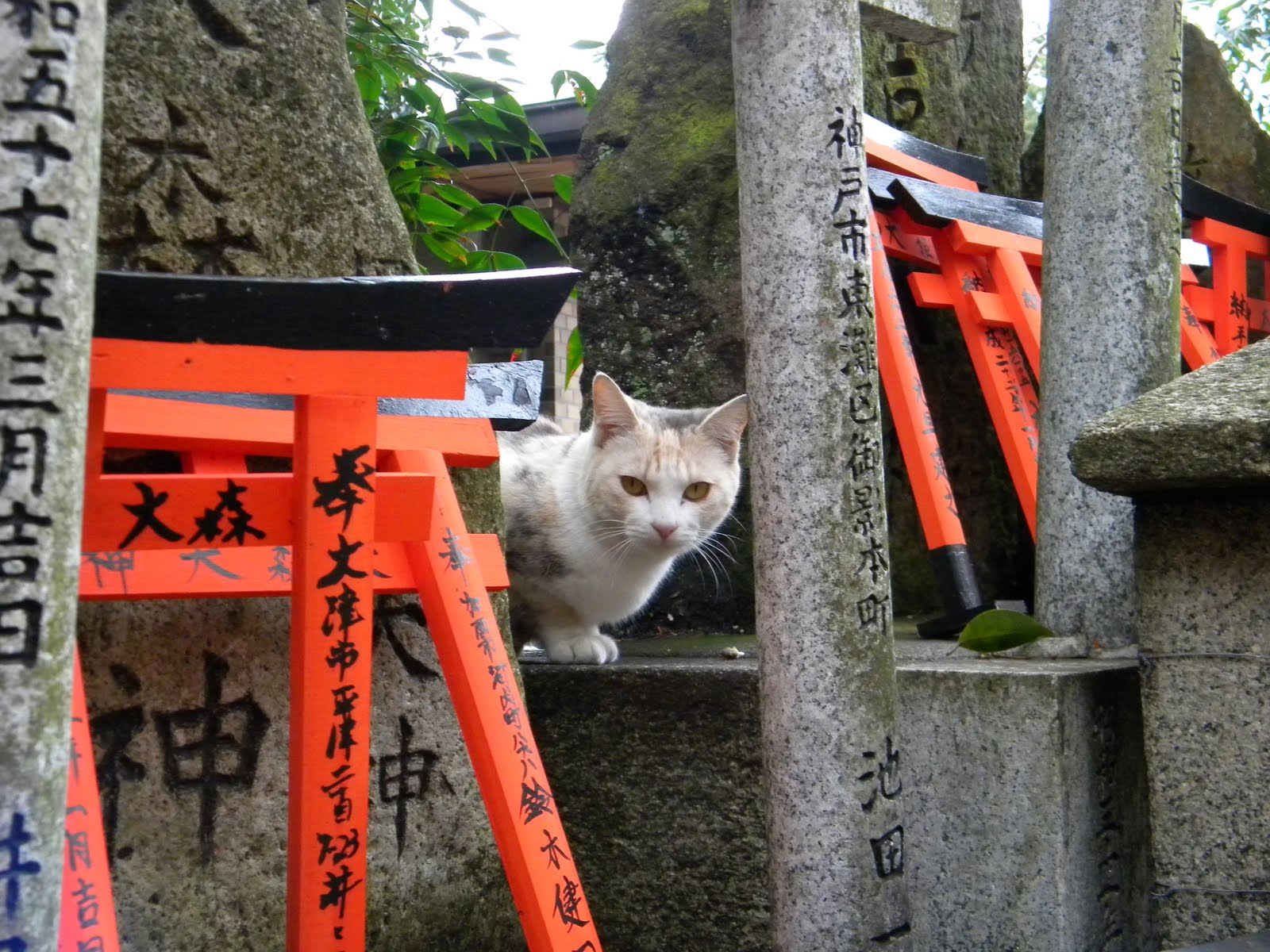
Next, I visit the Fushimi Inari Temple Complex at the edge of the city. With its hundreds of sunset-orange tori gates spanning the hillside, it's one of Kyoto's most iconic sites. After my long walk there, I must be a bit disheveled, for one of the vendors at the end of the trail grabs my hand and pulls me over by her table. For God and all the world to see, she strips me down to my underthings (which, fortunately, are plentiful) while a group of Finnish tourists stops to take photos of the event.


The Japanese lady then redresses me, wrapping the kimono tightly around my body. She untangles the long obi from its waterfall shape and ties it around my waist, refashioning it so that it is once again in the shape of a large bow. She then smiles proudly at her improvements on my appearance. It does seem tidier, with cleaner lines, now that everything is bound more closely to my frame.


Before arriving in Kyoto, I had imagined how wonderful it would be to see the cherry blossoms in a rural, isolated setting -- rice paddies with maybe a pagoda or two on the skyline. Kyoto is nothing like that. While the city is a living treasury of historic temples and beautifully-tiered pagodas, it's also packed with people. Some of the people are European and (non-Japanese) Asian tourists, but mostly the city is crowded with people local to Kyoto and various other cities in Japan. I unexpectedly love it, the crowds. There's something touching about being surrounded by families, groups of friends, and other solo travellers who are all there for the same simple reason as me: to celebrate some of the beauty the world has to offer.


{The photo does not do it justice. The weeping cherry tree at Maruyama Koen is the most beautiful thing I've seen in my whole life.}

The blush-pink and starry-white cherry blossoms which indiscriminately decorate the city, next to pagodas and homes, in school yards and parks, next to rivers and on tiny, otherwise unlovely, dead-end streets, seem to offer a lesson.

We always have the choice of whether to open ourselves to the world. We've all been hurt in various ways; it's easiest to stay closed. But how much better it is to let our hearts and lives, like the wild white cherry trees, burst into blossom without holding back.

Tuesday, May 10, 2011

Cherry Blossoms in Korea


{flower thieves}
{"He loves me. He loves me not. . . . This is gonna take a while."}

Cherry blossom viewing in Korea is met with the same sort of enthusiastic hedonism that I've previously only encountered in American malls on Black Friday morning.

"Please do not pick the cherry blossoms," a woman's voice pathetically pleads over an intercom.

"If you pick the cherry blossoms, we will have nothing for our festival. Enjoy with eyes only," she announces in Korean, English, and Japanese at regular intervals throughout the afternoon.


Meanwhile, young women pull bouquets of white blossoms from the trees, nestle them in their silky black hair, pose coyly for photos. The guys also pick flowers and affix clusters of them to their button holes, or sometimes allow their girlfriends to arrange the flowers on their heads for more photos, this time funny. Some couples walk down the avenue with entire branches of cherry blossoms entwined in their hands. One woman carries what appears to be a small sapling tugged from the earth.

Cherry blossom parties in Seoul are chaotic, noisy, joyful. I estimate there are around 2,000 people at the Yeouido Festival at the same time I'm there, at least 3,000 of which are kids brandishing sticks. (Statistics don't lie, people.)


{monks walking through Yeouido}

I watch as a child rams a young woman in the eye with the stick he is carrying while his mother, right by side his side, looks on. Instead of reprimanding her stick-wielding child before he'd injured someone, the mother waits until after the injury takes place and then apologizes and bows, and the injured young woman, shaking in pain and with her hand covering one eye -- trying to shove the eyeball back into its socket, perhaps -- bows in return.

Rather than be the next victim of the Cyclops effect, as caused by the happy, stick-wielding herds of children, I decide to distance myself from the crowd. Escaping the masses, I pitch myself over the guard rail and tumble a few steps down a small cliff, to a tiny thread of a dirt trail that is partway down the embankment, poised between a highway filled with traffic below and a seemingly endless line of people above. In this middle ground, however, is a singular area of peace.


Another woman, who has also skittered down the embankment, offers to take my photo. She is the only person I see while I'm in this area.

I stick my face inside a cloud of snowy white bloom to see if the blossoms smell. They don't. I emerge with saffron-hued powder that dusts my chin and the tip of my nose. But that's okay -- it gives me that jovial, subtly-clownish air that's always been lacking in my appearance, I decide, hours later, when I finally look in a mirror and realize I spent my entire day thus embellished.


The only other woman leaves the little dirt path. The further I walk along the path, the more narrow it becomes. I crawl back up to the crowds.

There are several bands and other musical acts performing on the cherry tree-lined street in Yeouido, but since the place is so crowded, there is no possible way for the bands to march. So they don't. They stay firmly in place, standing in perfect line formation, and play their instruments this way.


On two separate occasions, attempts are made to lure me into a traditional Korean dance performance -- with a success rate of 50%. I turn down the pumba performer, who breathes the dragonfire known as soju as he leers and invites me to perform with him. No, no, I wave my hands. Too shy.


But when the gold-toothed adjumma in the center of a different musical crowd begins tugging my arm into the midst of musicians and dancers and, taking my hand, swings me round and round closer into the crazy locus of drums and songs, I let her and let myself dissolve into the joyful chaos of it all. At the end of our song, she gives me her gilded smile and pats both my breasts in approval. Or possibly it was a complimentary breast exam. People are very diligent about their health checks here.

The day before, I walked around enjoying the cherry blossoms at Children's Grand Park. !!! I think, as I watch two older ladies pull aside a policeman and dramatically wave their hands in the air, gesticulating excitedly while reporting some sort of crime. I hang back to see what it could possibly be. The park looks so safe.


The policeman leaves the two older women and goes forth somewhat reluctantly. He turns back to them. They toss their arms about in the direction of the guilty party and shout for the policeman to get on with it. So he does his duty, and puffing up his chest with the pride that befits his role in protecting his country, tells a couple on a nearby park bench that they must stop kissing. It's illegal. Or something.


{pagoda at Children's Grand Park}

So, as you can see by the above example, I'm not exactly a rookie when it comes to witnessing matters of criminal activity. Nonetheless, I am very shocked when -- the very next day -- a man runs past me along the cherry-lined path in Yeouido, so quickly and closely to me that the breath of his body ruffles my hair. He flings himself off the cliff without pause. A suicide attempt, I think, horrified, and rush with all the other nearby people to the edge of the embankment. Before the crowd even fully assembles there, however, three policemen come running past and also throw themselves off the cliff. I look down but there are no bodies. It really is rather small, so far as cliffs are concerned, but nonetheless I find it amazing that the entire group of them, criminal and policemen, continue running after flying down it. I quickly lose sight of them and no one can tell me what happened. Therefore, I can only conclude that the criminal in question had kissed a lot of women.

Almost more quickly than the time it took for the running man and three policemen to dive off the cliff, the crowd of onlookers becomes enveloped once more into the task of walking beneath the cherry trees.

A young man jumps up and laughingly grabs hold of a tree branch, shaking it so the white petals loosen and fall all around us.

I reach up then, as well, pull down a sprig of the starry white flowers, and nestle them behind my ear. Life is good, or at least, as always, it's interesting.


{cherry blossoms and blue, blue sky}