Showing posts with label Japan_Kyoto. Show all posts

Monday, May 16, 2011

Cherry Blossoms in Japan


Although I go to Japan as a solo traveler, I find that I am rarely alone. In Kyoto, especially, I am often approached by Japanese ladies, usually in pairs.

Where are you going? Are you lost? Can I help you?


It is this seemingly never-ending kindness as I'm passed from one stranger to the next until I reach my intended destination that endears the country to me. While I'm rather infamously bad at following directions, locating compass points, reading maps -- anything, really, that would mark me as someone capable of leaving her own back yard -- I am never, ever lost in Japan for longer than a 5 minute stretch. Any trace of puzzlement on my face or the action of unfolding my map is like a cry for help and the Japanese ladies nearest me immediately rush to express their concern, put me on the right bus, walk me to the sushi restaurant I'm trying to find, plot out my course and quiz me after to make sure their directions are clear. Their kindness is overwhelming.


Often, a pair of them will take it upon themselves to give me a tour of whatever temple I happen to be in. See the tree in the corner of the garden? It is old. See these roof tiles? They are old. *pause for dramatic effect* Very old.


{The Silver Pavilion is old.}

Maybe the information they give me is not quite as precise as that I might receive were I to actually hire a professional tour guide, but even if I was told the exact dates, my memory would sooner or later sort them into the categories of "old" and "very old," so in the end, it's all the same.


{The Golden Pavilion was old. But then a monk fell in love with it -- yes, the building -- and burnt it to the ground so no one else could have it. The rebuilt structure is mostly new.}

The Japanese ladies are also very solicitous about helping me dress. On my previous visit to Japan, I bought a used kimono of coral silk with delicate silver branches embroidered across it and sleeves that drip halfway to the ground, indicator that I am unmarried. I also have a floral, tapestry-type obi (belt) and linen undergarments someone gave me to wear with it. However, in spite of the lengthy instructions I've printed from the web, I'm not entirely confident in dressing myself in these items. If I wrap the kimono in the wrong direction, it indicates that I'm dead. Even worse is the matter of trying to tie the obi, an elaborate and complicated procedure.

At one of my hostels (I change hostels every night because the entire city is booked during sakura season), I meet a friendly Japanese girl named Asuka.

"Do you know how to wear a kimono?" I ask and show her my clothing spread. Asuka drapes the kimono in slightly loose folds around me and carefully ties the obi into an oversized bow in the back.


I happily wander around the city like this and get as much attention as Mickey Mouse at Disneyland: everyone from Japanese salarymen to Western tourists wants their photo with me. But when I get to Maruyama Koen Park, one of the Japanese ladies tilts her head at me and frowns. Without a word, she undoes my obi and reties it into a different shape, a sort of waterfall design, and then smiles. All better.


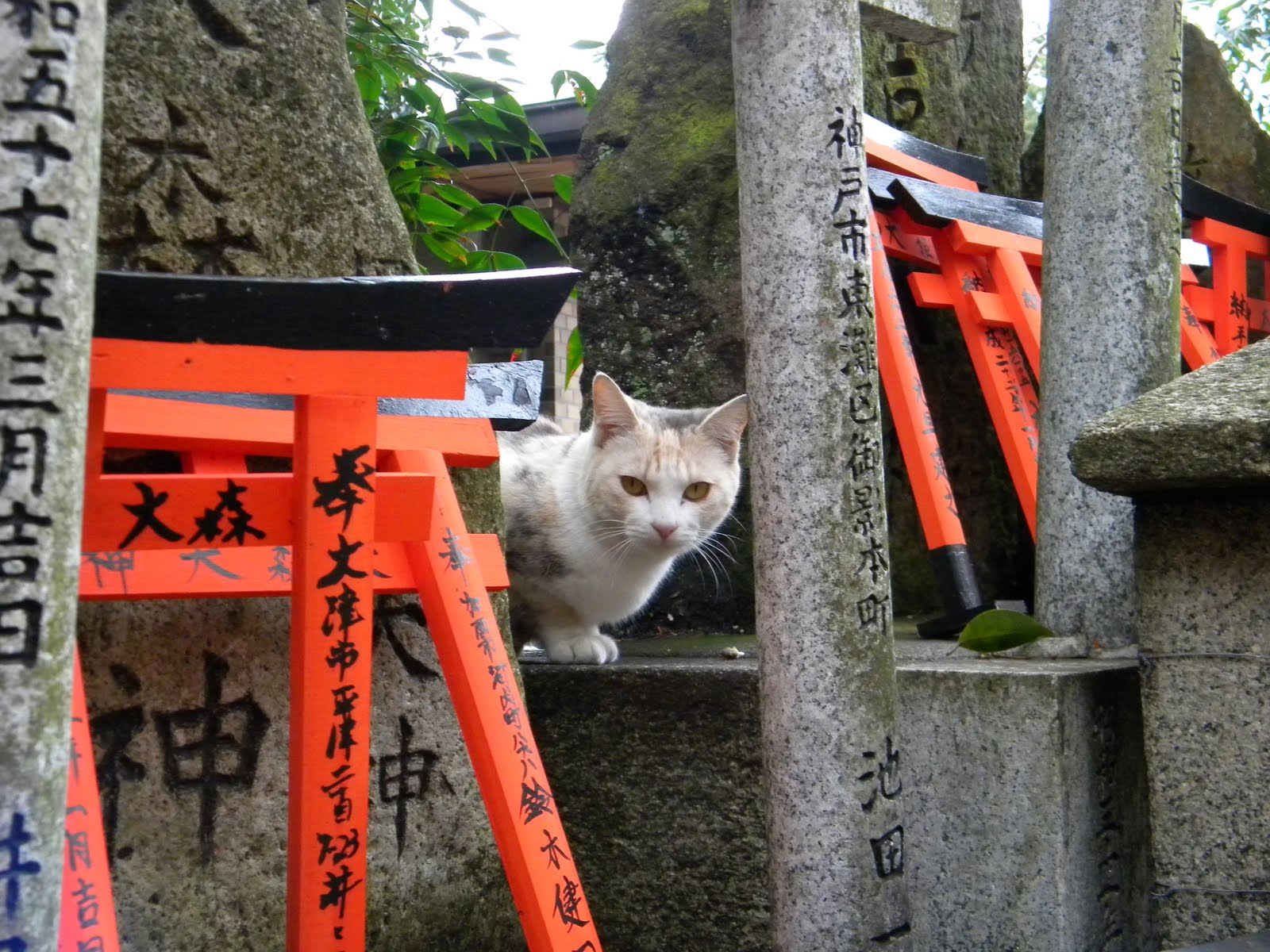
Next, I visit the Fushimi Inari Temple Complex at the edge of the city. With its hundreds of sunset-orange tori gates spanning the hillside, it's one of Kyoto's most iconic sites. After my long walk there, I must be a bit disheveled, for one of the vendors at the end of the trail grabs my hand and pulls me over by her table. For God and all the world to see, she strips me down to my underthings (which, fortunately, are plentiful) while a group of Finnish tourists stops to take photos of the event.


The Japanese lady then redresses me, wrapping the kimono tightly around my body. She untangles the long obi from its waterfall shape and ties it around my waist, refashioning it so that it is once again in the shape of a large bow. She then smiles proudly at her improvements on my appearance. It does seem tidier, with cleaner lines, now that everything is bound more closely to my frame.



Before arriving in Kyoto, I had imagined how wonderful it would be to see the cherry blossoms in a rural, isolated setting -- rice paddies with maybe a pagoda or two on the skyline. Kyoto is nothing like that. While the city is a living treasury of historic temples and beautifully-tiered pagodas, it's also packed with people. Some of the people are European and (non-Japanese) Asian tourists, but mostly the city is crowded with people local to Kyoto and various other cities in Japan. I unexpectedly love it, the crowds. There's something touching about being surrounded by families, groups of friends, and other solo travellers who are all there for the same simple reason as me: to celebrate some of the beauty the world has to offer.


{The photo does not do it justice. The weeping cherry tree at Maruyama Koen is the most beautiful thing I've seen in my whole life.}

The blush-pink and starry-white cherry blossoms which indiscriminately decorate the city, next to pagodas and homes, in school yards and parks, next to rivers and on tiny, otherwise unlovely, dead-end streets, seem to offer a lesson.

We always have the choice of whether to open ourselves to the world. We've all been hurt in various ways; it's easiest to stay closed. But how much better it is to let our hearts and lives, like the wild white cherry trees, burst into blossom without holding back.

Wednesday, August 18, 2010

The Trouble with Wishes


"True love and adventure," I think while watching a falling star arc in a platinum streak across the sky. "True love and adventure," I think as I blow the angelic white puff of dandelion seed. "True love and adventure," I mumble while closing my eyes and blowing out birthday candles. These have been my wishes for at least the past the dozen years, which is really the only natural outcome of a childish belief that The Princess Bride was based on a true story.

I am dropping one of my wishes.


Huddled against a pile of futon cushions under the stairs, I glance up warily as a new girl entered the room.

"Hello!" she chirps at me. "Are you an escort lady, too?"

My trip to Japan is not what I had expected.

It is, in fact –


The route that has led me to camp out nearly a week on the floor of a Japanese escort is too convoluted to easily relate. Suffice it to say that circumstances with my visa (credit/debit card) left me virtually without money and circumstances with my visa (working papers for Korea) left me stuck in Japan until my new workplace actually got the paperwork right. In the meantime, my workplace refused to give me a hotel voucher beyond one night, stating that it “would be unfair to the other employees.” HR’s concern was nonexistent. And her incompetence only compounded the problem. I learned that the one night's hotel voucher was actually good for the night before I arrived in Japan; also, HR had sent me out of Korea without the confirmation number that was necessary for my return, which made my stay in Japan indefinite; the plane ticket she gave me did not have a return flight on the same day as she had told me; the maps she e-mailed me were to the wrong embassy; and after I finally did receive a confirmation number from her, it was impossible to change my flight and go back to Korea without purchasing a new plane ticket. At this point, I’d like to once again point out the whole “no money” issue. The only way I got through this was by: 1. The kindness of a Japanese escort I’ll call Mameha and 2. My ability to make the impossible possible. (This only sounds like bragging because I’m bragging.) Oh, and not to forget, 3. The wish.


(No, I said wish.)

My time in Osaka is not entirely bad. Mameha’s apartment is just a 10 minute walk from Osaka castle, so I often walk the castle grounds during my stay there. Also, one night, Mameha and I dress in yukatas and roam the streets of the Osaka district nicknamed “Amerika Town.” This area has a mini Statue of Liberty, a surplus of jean stores, and Japanese youth who dress like Americans. I stare at them in their jeans and tight, heavy metal t-shirts. They stare at me in my yukata. Each of us is a little lost in the fantasy of otherness.


So, like I said, it is not entirely bad. But it is also not entirely good. I can not do much touring because I always need to be near an Internet café, so that I can check my e-mail several times a day, in hopes that my confirmation number will arrive. I am always just a little bit hungry, though I do manage to eat sushi for my one meal nearly every day I was there. Living like a queen for one meal a day is better than multiple bowls of ramen, in my opinion.


(Yes, I am nearly entirely broke, but this is the sort of wardrobe I packed.)

But most taxing of all, I feel under constant pressure. It is one thing to put yourself under a strict budget for a certain number of days. The locus of my stress is that the number of days is X, an unknown quantity. What if after all my budgeting I end up running out of money completely? What if Mameha gets tired of having me underfoot?


(At least two of these people also find it difficult to understand the customs when traveling abroad.)

The unknown is a weight I carry with me every day, until one day I realize that I need to go on holiday from myself. I put on my prettiest dress, the one that's the bright yellow of sunshine and daffodils, and board the train for Kyoto.


When I first arrive in Kyoto, I simply wander the streets in one of the old quarters.


I go to an ancient wooden pagoda that had enchanted me on my previous visit to Kyoto in the spring, and the nearby colourful, quirky monkey shrine. The main altar of the monkey shrine features three chipped and cheeky monkey statues in the classic “hear no evil, see no evil, speak no evil” poses.


And from the shrine just before the temple, as well as in the backdrop of the temple itself, there dangle row upon row of what look like triads of balls. These colourful cloth balls actually represent even more monkeys. People write their bad habits on the monkeys – habits they wish to rid themselves of – and then hang the monkeys on the shrine. Then whenever they indulge in their bad habits, monkeys will come and plague them, thus an incentive to stop the bad habits. Nifty, huh?

My only real objective for this trip is revisiting the Kiyomizudera Temple, the temple in the clouds. This is another place I had visited in the spring, but it was during a special night show for the cherry blossoms, and the impressive height was hidden by the darkness. When I saw photos of Kiyomizudera Temple in the daytime, I determined to return there.


And Kiyomizudera, originally built in 798 and listed as one of the 21 contenders for the world's "new" seven wonders, is certainly worth a second look, being perched above Kyoto proper, with several of the temple’s largest buildings held above the hilltop and surrounding trees by a crisscross of massive wooden beams. Impressively, not a single nail is used in this structure.


I discover a small side path from the main temples. Entering the area of the Jishu Shrine, I am immediately accosted by the bronze statues of a man with a raised mallet and a rabbit standing on its hind legs, much in Alice in Wonderland style.


(Um, I wish not to get hit in the head by a mallet?)

Nearby is a dragon fountain, with water to wash away your bad luck, or possibly just to wash away your dirt. The heat is blistering, so I splash water against my hands to cool them, and then drip the cold water so that it trickles down the back of my neck.


Then, most interestingly, I notice a set of two stones, 20 feet apart, with a placard before the first one that is translated to read something like “Pass between these two stones while closing your eyes and coming to no harm, and your heart’s desire will be granted.”


I look at the stones and then look at the people swarming around me. “This is stupid,” I tell myself. “People are going to think I’m crazy. And if walking blindly between two stones doesn’t suggest insanity, talking out loud to myself should do the trick,” I murmur.

I position myself in front of the first stone, the back of my heels pressed against it. I close my eyes and hold out my hands to either side. Back in the day, it may not have been so hard to walk from one stone to the other, but now there is an ever shifting mass of tourists and devotees passing through the area.

My self-consciousness eases considerably after closing my eyes. Like a child, I almost feel as though the other people now cannot see me. I take one tiny step forward, pretending that I am walking on a tightrope. After all, how hard can it be to walk a straight line?

But I find a number of distractions. With my sight shut off, my other sense immediately expand. The white noise of people speaking in other languages, a sound which I’d come to tune out during my past year in Asia, suddenly strikes my hearing with a confusion of sounds. I can also hear music in the distance, most likely emanating from one of the nearby temples, playing from an instrument I can not recognize. Incense is thick in the air, with scent as heavy as a cloud, nearly palpable as rain.


I walk forward slowly, almost solemnly. At one point, the skin from another woman’s arm flutters beneath my fingertips. An another point, I reach out my hand and lay it against the smooth surface of a counter. I have gone off course, somewhere to the left of the stones, and am apparently at the booth that sells prayer charms and paper fortunes. It is then I hear a voice.

“You’re doing good,” the voice encourages. “Step to the right now.”

I blindly follow the voice’s instructions. “Great!” the voice says, “Just take a few steps back to the left. That’s it. Keep walking.”

“Do I have much farther?” I ask. It feel as though I’d already spent 10 minutes covering the smallest possible portion of ground.

“Not too much further,” the voice replies. “Move towards my voice. Wait, stop a minute. Ok, you’re good now. Keep coming.”

I walk forward in faith, trusting this stranger I’d never seen to guide me.

“That’s perfect! Congratulations!” the voice enthuses.

A second later and my foot came into light contact with the second stone. My wish, whatever I choose to make it, will be granted.