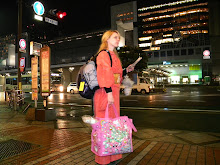
The trouble with only learning the pleasantries of a foreign language is that they are only useful in situations that are, well, pleasant. Should an insult be offered, this leaves you with no language for reply. Personally, the best I could manage would be to harvest from the sparse stock of pleasant, friend-making Korean phrases I've memorized and add "no" to them. Imagine this being the fiercest retort you are capable of making:
Respected sir, do I like you? No! Respected sir, are you fun? No! Are you cool? No! Are you pretty? No!
There are times when such language is not quite strong enough for the situation at hand.
The first time I am mistaken for a whore is on the subway platform at Namdaemun Station. I am wearing blue jeans, a bulky winter coat, a scarf, a backpack. A Lonely Planet guidebook is in my hand.
"I love you," says the man who, at the time, is just a few feet from me. He raises his arms above his head and bends them in the shape of a crooked heart. He shuffles back and forth on wobbly feet.
"Thank you," I reply, smiling. Just the week before, a different man on a different subway platform had repeatedly proclaimed to me that he loved America and loved Americans. I figure this man's declaration is something along the same lines. How nice.
The man moves closer to me. His face is puffy and pink, an old, bloated, babyish face. His bleary eyes are rimmed in red. His breath emits a hazy cloud of soju as he asks, "Where are you going?"
"I'm just going home," I say, still smiling.
"I want you to come home with me," he says.
Again, how nice. He is inviting me back for tea with his family, I think with a naivety that casts its faint glow about me like a halo.
The man opens his wallet.
He's going to show me a photo of his wife and kids, I think.
He pulls out money.
But where are his wife and kids? I wonder.
"This is Korean money," he says, trying to shove a couple of bills into my hand. I curl up my fingers to refuse the money. Confused, I alter my stream of thought, trying to make sense of this unforeseen happening: Could he be a black market money changer? Is he looking for U.S. dollars? I ponder these unlikely possibilities for a minute.
Then, the fog of innocence finally lifts from me.
I am horrified.
And I only say "horrified" because I don't know a stronger word. There is no kind old man standing before me, trying to become my friend. There is only a drunken lech trying to pick up a whore, trying to pick up me.
A Korean woman, standing nearby on the subway platform, watches the entire situation play out in front of her. She is wearing a micro-mini skirt and 4-inch heels, in line with the aesthetics of modern Korean fashion. But it doesn't matter what she wears: She is Korean, so she is pure and well-respected. A Korean man would never offer her money for sex. The woman begins to laugh at me, laughs at the bewilderment and disgust that I can feel myself projecting through every ligament of my body.
My face crumples. I run away to the far end of the subway and quietly cry the whole ride home. It isn't until later that I think about how the wad of money the man had shoved toward me was around 13,000 won. Not only was I considered a whore, I was considered a $10 whore.
The next few times I am mistaken for a whore are also hard on me, although less painfully so, as I can now understand the signals much sooner.
"How much?" a man will sometimes ask as he passes me.
Now, when a man says something like that, I look him dead in the eye and, with unleashed venom, snarl, "You wish."
And then I run away and cry. Because continuity is always a good thing. Right?
{For those of you still confused about the difference between me and a whore, here is a little photo illustrative.}
{what an actual whore wears for a night out on the town}
{what I wear for a night out on the town}
I have a close friend, another foreign woman, to whom I told about these happenings in whispers. She lives in Itaewon, the notoriously sketchy expat district of Seoul, and has never experienced anything like it herself.
This made me feel even worse. Is it just me? And is this how I look to every Korean man, like a whore? Maybe they all believe I'm a whore but some of them simply don't require my services, I think with what may or may not be paranoia.
And up until about a week ago, I never mentioned it to anyone else. I was too ashamed. Finally, last week, after my third "offer" within the course of two consecutive days, I couldn't contain my resentment any longer. I went to a swing dance and polled the three other foreign women there, rather abruptly asking if they, too, had ever been treated like whores.
"Well, only the one time," one foreigner shyly admitted. "But I was dressed really nice, conservatively!"
"Yeah, like every time I leave the apartment," another American woman said.
"A couple of times, sure," confided the third foreign woman.
I want to throw things. I want to throw things at the heads of the men who try to rent my body by the hour. I want to throw (smaller) things at the one or two guys I have since told about it and who counter with jokes. It's not a laughing matter.
I'm writing this because I'm angry and I'm insulted and I'm tired of feeling ashamed. I didn't do anything wrong. There is shame here, certainly; but that shame is not my burden.
I love so much about my life in Korea and the friends I've made here. I have met some Koreans, both men and women, who shine with pure goodness. It can be a truly wonderful country to live in. But not in this regard. This is a side of Korea that is not funny, not cool, and most definitely not pretty.
Showing posts with label Expat Life. Show all posts
Wednesday, July 6, 2011
Monday, June 27, 2011
The Unauthorized Autobiography of Captain Polyglot
I am an expert at all things that are not Korean. You may not believe this. And I may not believe this. But all the Korean employees at my workplace unequivocally believe this. They believe it the same way 4-year-olds believe in Santa Claus. And with utter confidence in my far-reaching knowledge of all things not Korean, they ask me for information regarding words in French, German, Portuguese, etc.
Sadly, though, I am not what you'd call a "language person." It's true that while in university, I took one year of accelerated classes in Italian and was always at the top of my class, but in spite of my almost-adequate grasp of Italian while in uni, my knowledge of it has receded in the years since so that now the only thing I feel confident about in Italian is how to order an ice cream. Really, this is the most important phrase anyone can use in Italy, anyway, so that's all good. But to return to the shores of my now-distant main point, my knowledge of ordering ice cream has become the basis for my understanding of all Romantic languages, so that I feel sufficiently informed to take a stab at defining pretty much any foreign word that my coworkers present to me.
Also, I cheat and use the Internet.
"Oh yes, ajdiwureojaksldfj, yes, of course I'm familiar with it. I'm just a little busy now. Give me a minute and {Google, Google, Google, Wiki, Wiki}, yes, it means 'the velvet canvas on which religious icons are painted by Polish farmhands.' And it's pronounced *imitates cat unsuccessfully trying to rid
As you might imagine, this system works very well for me. By which I mean, I still have a job.
Sometimes, though, my coworkers will hand me a paper with a word that's -- not to be judgmental or anything -- totally weird.
I take the piece of paper and squint at it. Pretend astigmatism makes an excellent stall for time.
"That's not an English word. No, it's sure not," I'll observe as I stare at a word in Yiddish? Russian? Something-stan?
"Errm, it's not even written in the Roman alphabet," I'll then point out, in what I intend as a mild protest.
"Yes, that's true," my coworkers will respond, smiling. "And how do you pronounce it?"
The result of which is that one of our language CDs may or may not have a speaker mentioning farflugen where a Yiddish-Russian-Something-stan word would actually be more appropriate. Because farflugen is the most exotic-sounding word I know. I think the Swedish chef from The Muppets used to say it, so I guess that makes farflugen Swedish. Who says you can't learn by watching prodigious quantities of TV?
Sometimes, to be perfectly frank, I feel I'm not the best person for this job. However, I seem to be the company favourite, as out of the three native English speakers in my office, I am decidedly the one most often chosen to answer questions about all things not Korean.
I once overheard a conversation between a Korean coworker and one of the other native English speakers, Evil Disney Princess (a moniker bestowed for her unique ability to say the meanest things imaginable in a voice sweet as honey), about a certain English word. I didn't hear the whole convo, but distinctly heard EDP advise that "The dictionary is wrong about that word."
Perhaps that is why I've been designated as Captain Polyglot. I never tilt at Oxford or Webster. And as for Roget, I feel absolute adulation, affection, devotion, emotion, passion, rapture, relish, and respect.
Anyway, I was just kidding about that farflugen stuff. But if you ever hear the word "onomatopoeia" seemingly used out of context on an EFL CD. Well, that one just might be me.
Thursday, June 9, 2011
Bow-Wow Soup in Korea or "What's for Dinner?"
Seolmi and I angle our chopsticks into the various dishes spread across the table. We use them like tiny extended hands to pick up long strands of fried noodles, udon-infused squares of fishcake, and pieces of delectably tender sushi. Our conversation drifts in and out of various topics. I take a bite of the sushi and rave about its deliciousness.
"Mmm, this fish tastes great!" I enthuse.
"Have you had dog or cat?" Seolmi asks.
"No, no! Never!" I protest.
In the shadow of its other culinary offerings, Korea has a reputation for serving bosintang or meong meong soup (the latter of which translates to "bow wow" or "woof woof" soup) in a few, select restaurants tucked away in some of Seoul's poorer alleyways.
Images flash through my mind of all the dogs who have reached cult-like status via Western movies and TV: Beethoven, Benji, Toto, centuplicate (+service) Dalmatians, and the most classic canine of them all, Lassie. It didn't matter how many times little Timmy fell down that well (being so very accident-prone as to make viewers wonder whether he harbored latent suicidal tendencies), the border collie Lassie was always there to save him. No one should ever have Lassie for dinner.
"I would never do that!" I proclaim emphatically. "I would never have dog or cat. For me, it would be like eating a baby!"
I pause in the midst of my raving and look more closely at Seolmi. She has a strange expression on her face that I can't quite read, and her mouth hangs open slightly.
Quickly, I switch the nature of my speech. I've been so insensitive. Maybe Seolmi's parents raised her on woof woof soup. Maybe her grandparents had resorted to eating it due to lack of better food options during the war and the tradition carried down a few generations. Who am I to judge another person's culture, especially someone who is trying to be my friend?
"It's okay if you eat dog," I amend apologetically. "We're from different cultures. I understand that."
Then there is silence. A long silence.
Finally, Seolmi speaks.
"Not eating dog or cat," she says. "Having dog or cat. For pet."
Friday, May 20, 2011
A Smurfy Sort of Day: Office Life in Korea
A smurf has wandered into our office -- Smurfette herself, to be more specific. "Why?" I keep asking my coworkers, but no one seems to know. This makes today pretty much the same as any other day in Korea, when I also don't understand much of what's going on.
The good part to constantly being perplexed by my surroundings? I've learned to let things go, drift along with the currents that are moving through the city and my daily life. Ignorance is Zen.
Smurfette, who is much larger in the real life than the cartoon ever led me to believe, wanders up and down our office aisles. She carries a long yellow stick with a molded plastic hand attached to the end of it. For a while, she seems content with simply using her stick to poke office workers in the back. Then she rocks back and forth in silent laughter as the more attentive workers, who just seconds previously were focused on the computer screen in front of them, leap from their seats in surprise. Soon enough, though, the whole office is made aware of Smurfette's presence. Without the element of surprise, she begins to grow weary of this game.
Next, Smurfette moves on to the ever-popular Korean pastime of "rock paper scissors." Smurfette uses her real hand (well, comparatively real -- it is blue, fuzzy, and more mobile than her yellow stick hand) to play rock paper scissors. My coworkers who win are given what appear to be delicious pasties but are actually fancy bars of soap molded into pastry replicas. My coworkers who lose are given a pretend slap in the face with the fake yellow hand. I can't look away.
Soon enough, Chun Kyung, the office worker who sits next to me, notices my fascination with the smurf and pulls her over to play with me. I am proud to report that my cunning strategy and flawless execution while competing in rock paper scissors allows me to receive a soap rather a slap.
"Yellow hair! Yellow hair!" all the textbook workers closest to me cry, pointing at the obvious similarity between me and the tall blue creature beside me. Even Smurfette herself seems impressed by this parallel in our appearance. She gently thumps her hand against the top of my head, as though I were some sort of exotic pet belonging to the smurf community.
"You're sisters," Ji Hee smirks.
I still don't know why any of it happened.
Tuesday, May 10, 2011
Cherry Blossoms in Korea
{flower thieves}
{"He loves me. He loves me not. . . . This is gonna take a while."}
Cherry blossom viewing in Korea is met with the same sort of enthusiastic hedonism that I've previously only encountered in American malls on Black Friday morning.
"Please do not pick the cherry blossoms," a woman's voice pathetically pleads over an intercom.
"If you pick the cherry blossoms, we will have nothing for our festival. Enjoy with eyes only," she announces in Korean, English, and Japanese at regular intervals throughout the afternoon.
Meanwhile, young women pull bouquets of white blossoms from the trees, nestle them in their silky black hair, pose coyly for photos. The guys also pick flowers and affix clusters of them to their button holes, or sometimes allow their girlfriends to arrange the flowers on their heads for more photos, this time funny. Some couples walk down the avenue with entire branches of cherry blossoms entwined in their hands. One woman carries what appears to be a small sapling tugged from the earth.
Cherry blossom parties in Seoul are chaotic, noisy, joyful. I estimate there are around 2,000 people at the Yeouido Festival at the same time I'm there, at least 3,000 of which are kids brandishing sticks. (Statistics don't lie, people.)
{monks walking through Yeouido}
I watch as a child rams a young woman in the eye with the stick he is carrying while his mother, right by side his side, looks on. Instead of reprimanding her stick-wielding child before he'd injured someone, the mother waits until after the injury takes place and then apologizes and bows, and the injured young woman, shaking in pain and with her hand covering one eye -- trying to shove the eyeball back into its socket, perhaps -- bows in return.
Rather than be the next victim of the Cyclops effect, as caused by the happy, stick-wielding herds of children, I decide to distance myself from the crowd. Escaping the masses, I pitch myself over the guard rail and tumble a few steps down a small cliff, to a tiny thread of a dirt trail that is partway down the embankment, poised between a highway filled with traffic below and a seemingly endless line of people above. In this middle ground, however, is a singular area of peace.
Another woman, who has also skittered down the embankment, offers to take my photo. She is the only person I see while I'm in this area.
I stick my face inside a cloud of snowy white bloom to see if the blossoms smell. They don't. I emerge with saffron-hued powder that dusts my chin and the tip of my nose. But that's okay -- it gives me that jovial, subtly-clownish air that's always been lacking in my appearance, I decide, hours later, when I finally look in a mirror and realize I spent my entire day thus embellished.
The only other woman leaves the little dirt path. The further I walk along the path, the more narrow it becomes. I crawl back up to the crowds.
There are several bands and other musical acts performing on the cherry tree-lined street in Yeouido, but since the place is so crowded, there is no possible way for the bands to march. So they don't. They stay firmly in place, standing in perfect line formation, and play their instruments this way.
On two separate occasions, attempts are made to lure me into a traditional Korean dance performance -- with a success rate of 50%. I turn down the pumba performer, who breathes the dragonfire known as soju as he leers and invites me to perform with him. No, no, I wave my hands. Too shy.
But when the gold-toothed adjumma in the center of a different musical crowd begins tugging my arm into the midst of musicians and dancers and, taking my hand, swings me round and round closer into the crazy locus of drums and songs, I let her and let myself dissolve into the joyful chaos of it all. At the end of our song, she gives me her gilded smile and pats both my breasts in approval. Or possibly it was a complimentary breast exam. People are very diligent about their health checks here.
The day before, I walked around enjoying the cherry blossoms at Children's Grand Park. !!! I think, as I watch two older ladies pull aside a policeman and dramatically wave their hands in the air, gesticulating excitedly while reporting some sort of crime. I hang back to see what it could possibly be. The park looks so safe.
The policeman leaves the two older women and goes forth somewhat reluctantly. He turns back to them. They toss their arms about in the direction of the guilty party and shout for the policeman to get on with it. So he does his duty, and puffing up his chest with the pride that befits his role in protecting his country, tells a couple on a nearby park bench that they must stop kissing. It's illegal. Or something.
{pagoda at Children's Grand Park}
So, as you can see by the above example, I'm not exactly a rookie when it comes to witnessing matters of criminal activity. Nonetheless, I am very shocked when -- the very next day -- a man runs past me along the cherry-lined path in Yeouido, so quickly and closely to me that the breath of his body ruffles my hair. He flings himself off the cliff without pause. A suicide attempt, I think, horrified, and rush with all the other nearby people to the edge of the embankment. Before the crowd even fully assembles there, however, three policemen come running past and also throw themselves off the cliff. I look down but there are no bodies. It really is rather small, so far as cliffs are concerned, but nonetheless I find it amazing that the entire group of them, criminal and policemen, continue running after flying down it. I quickly lose sight of them and no one can tell me what happened. Therefore, I can only conclude that the criminal in question had kissed a lot of women.
Almost more quickly than the time it took for the running man and three policemen to dive off the cliff, the crowd of onlookers becomes enveloped once more into the task of walking beneath the cherry trees.
A young man jumps up and laughingly grabs hold of a tree branch, shaking it so the white petals loosen and fall all around us.
I reach up then, as well, pull down a sprig of the starry white flowers, and nestle them behind my ear. Life is good, or at least, as always, it's interesting.
{cherry blossoms and blue, blue sky}
Monday, November 1, 2010
Having My Sushi and Eating Spaghetti, Too
It's hard to flirt with a waiter while dining alone at an all-you-can-eat buffet.
Cute Waiter: You're pretty.
Me (coyly): Thank you. Umm, I don't really know how to say this, but . . . can you bring me another plate?
Cute Waiter: Another plate?
Me (looking fixedly at the floor): Thanks.
[The Cute Waiter begins to leave.]
Me: Oh, wait. I forgot to tell you something.
Waiter: Yes?
Me: I might also need a bowl for dessert.*
Really, I should never be allowed in buffet-style restaurants for the same reason that I should never be allowed to play putt-putt golf or become involved in a game of musical chairs. Those situations trigger my usually latent competitive streak and at such times I really, really want to win. You can't even imagine the amount of "reallys" I would have to pile into that sentence to modify how intent I become on winning. To me, the phrase "all you can eat" is a challenge, the words dyslexically transforming into a taunting "How much can you eat?" The diner stacking up the largest pile of empty plates wins.

(Last time I played musical chairs. . .)
The Cute Waiter, noticing the big gulps with which I consume my meal (or maybe he just has a prediliction for girls with a hearty appetite), brings over a plate of something. Just for me. Special. I didn't order it.
"Spaghetti!" he proclaims. "It is very delicious."
"Mmmm, yeah," I return with as much possible fake happiness as I can muster. Tomatoes are my least favorite food in the world and spaghetti, covered in their blood red sauce, seems just like a first cousin to them. Out of the food I dislike most in the world, spaghetti has to hit the top ten list. But my personal rule for eating anything given to me trumps my dislike. Besides that, it's free, and I do love the free.

(I also become competitive during events involving dancing, drinking, and/or Omar.)
After the Cute Waiter leaves, I poke the pile of spaghetti tentatively with my chopsticks. It is delicately coated in thin fish flakes, the type that visibly quiver while resting atop hot food items, leading me to believe, the first time I saw them, that the food was still alive. It's not. But a certain "Fear Factor" stigmata remains attached, in my mind at least, to the fish flakes.
I begin awkwardly gathering the spahetti strands into my chopsticks. They're thicker than normal spahetti pasta -- udon! I quickly verify as I take a bite. The bright red sauce that I was dreading turns out to be a type of hot sauce. There's probably tomato in there, too, but what with the intensity of the hot sauce and the little specks of chili freckling the strands, my taste buds have been bequeathed with a certain amount of numbness and can process little more than HOT. What's more is that the quivering fish flakes, which I still taste faintly, add a subtle tang to the whole thing. Tiny, surprise octopus tentacles make their way into my chopsticks as I continue to eat my spaghetti. The Cute Waiter was right: This is delicious spaghetti! Or delicious something. It definitely looks like spaghetti, especially if you take off your glasses and kinda squint your eyes at it.

(Photo of Sushi and Delicious Something)
Now divested of spaghetti obligations (I ate half and arranged the rest into a smallish-looking pile on my plate), it is time to take a new plate to the buffet and select my main course of sushi. There is a wide variety of sushi and thankfully the large number of patrons eating here ensure that it is fresh, not like the less popular sushi restaurant down the street where the chefs use spray bottles to squirt water on the dry, wilting sushi being presented in order to make it look more palatable, or maybe just to clean off the dust that has accumulated there.
I get orangey-pink salmon, eel in a sweet brown glaze, salty yellow fish roe that crunches when my teeth bite into it, fake crab which is rosy and bland except for the bitter mote of green wasabi used to adhere it to the rice ball, and several other fish I can't identify. I also get two pieces of egg sushi, which is a way of cheating at sushi, but it also tastes like the best omelet in the world which makes the cheating seem not so bad. And fries. They have thick-cut, seasoned fries in a hotplate, which make a satisfying, if unconventional, accompaniment to the sushi. Side soups include miso, mushroom, and soba noodles. I only get the first type of soup. Even a girl with high eating ambitions can't manage everything. Besides, I notice a dessert bar which offers, among other treats, patbingsu (red beans and ice), pastel balls of tteok filled with red bean sauce, and a sugar-coated dry ramen and chocolate mix. Who's up for thirds? Oh, waiter . . .
---------------------------------------------------------------------------
*Dialogue may be exaggerated, ala A Million Little Pieces memoir style.
Cute Waiter: You're pretty.
Me (coyly): Thank you. Umm, I don't really know how to say this, but . . . can you bring me another plate?
Cute Waiter: Another plate?
Me (looking fixedly at the floor): Thanks.
[The Cute Waiter begins to leave.]
Me: Oh, wait. I forgot to tell you something.
Waiter: Yes?
Me: I might also need a bowl for dessert.*
Really, I should never be allowed in buffet-style restaurants for the same reason that I should never be allowed to play putt-putt golf or become involved in a game of musical chairs. Those situations trigger my usually latent competitive streak and at such times I really, really want to win. You can't even imagine the amount of "reallys" I would have to pile into that sentence to modify how intent I become on winning. To me, the phrase "all you can eat" is a challenge, the words dyslexically transforming into a taunting "How much can you eat?" The diner stacking up the largest pile of empty plates wins.

(Last time I played musical chairs. . .)
The Cute Waiter, noticing the big gulps with which I consume my meal (or maybe he just has a prediliction for girls with a hearty appetite), brings over a plate of something. Just for me. Special. I didn't order it.
"Spaghetti!" he proclaims. "It is very delicious."
"Mmmm, yeah," I return with as much possible fake happiness as I can muster. Tomatoes are my least favorite food in the world and spaghetti, covered in their blood red sauce, seems just like a first cousin to them. Out of the food I dislike most in the world, spaghetti has to hit the top ten list. But my personal rule for eating anything given to me trumps my dislike. Besides that, it's free, and I do love the free.

(I also become competitive during events involving dancing, drinking, and/or Omar.)
After the Cute Waiter leaves, I poke the pile of spaghetti tentatively with my chopsticks. It is delicately coated in thin fish flakes, the type that visibly quiver while resting atop hot food items, leading me to believe, the first time I saw them, that the food was still alive. It's not. But a certain "Fear Factor" stigmata remains attached, in my mind at least, to the fish flakes.
I begin awkwardly gathering the spahetti strands into my chopsticks. They're thicker than normal spahetti pasta -- udon! I quickly verify as I take a bite. The bright red sauce that I was dreading turns out to be a type of hot sauce. There's probably tomato in there, too, but what with the intensity of the hot sauce and the little specks of chili freckling the strands, my taste buds have been bequeathed with a certain amount of numbness and can process little more than HOT. What's more is that the quivering fish flakes, which I still taste faintly, add a subtle tang to the whole thing. Tiny, surprise octopus tentacles make their way into my chopsticks as I continue to eat my spaghetti. The Cute Waiter was right: This is delicious spaghetti! Or delicious something. It definitely looks like spaghetti, especially if you take off your glasses and kinda squint your eyes at it.
(Photo of Sushi and Delicious Something)
Now divested of spaghetti obligations (I ate half and arranged the rest into a smallish-looking pile on my plate), it is time to take a new plate to the buffet and select my main course of sushi. There is a wide variety of sushi and thankfully the large number of patrons eating here ensure that it is fresh, not like the less popular sushi restaurant down the street where the chefs use spray bottles to squirt water on the dry, wilting sushi being presented in order to make it look more palatable, or maybe just to clean off the dust that has accumulated there.
I get orangey-pink salmon, eel in a sweet brown glaze, salty yellow fish roe that crunches when my teeth bite into it, fake crab which is rosy and bland except for the bitter mote of green wasabi used to adhere it to the rice ball, and several other fish I can't identify. I also get two pieces of egg sushi, which is a way of cheating at sushi, but it also tastes like the best omelet in the world which makes the cheating seem not so bad. And fries. They have thick-cut, seasoned fries in a hotplate, which make a satisfying, if unconventional, accompaniment to the sushi. Side soups include miso, mushroom, and soba noodles. I only get the first type of soup. Even a girl with high eating ambitions can't manage everything. Besides, I notice a dessert bar which offers, among other treats, patbingsu (red beans and ice), pastel balls of tteok filled with red bean sauce, and a sugar-coated dry ramen and chocolate mix. Who's up for thirds? Oh, waiter . . .
---------------------------------------------------------------------------
*Dialogue may be exaggerated, ala A Million Little Pieces memoir style.
Tuesday, October 19, 2010
The Worst Movie Review Ever: Eat, Pray, Love

This is the worst movie review you will ever read of Eat Pray Love. Let me clarify: It is definitely not the worst movie you will ever see (unless your viewing selection is dedicated entirely to Masterpiece Theatre and PBS marathons, in which case you are probably too smart to be reading my blog anyways. Seriously. If you're one of those people, stop reading my blog and invest the next 10 minutes in doing something more worthy of your talents, such as learning how to play the cello or mastering a fifth language. Thank you. Now, back to the normal people, the plebeians, or "pleebs" as I like to call us.); however, this actual review of the movie will likely be the worst you'll ever read, since I'm not even going to pretend to stay focused on the actual plot or the acting, and if the convoluted syntax of this sentence hasn't already convinced you how rambling this review aspires to be, then nothing will.
Eat Pray Love features a divorced American woman in search of herself as she travels the beautiful and exotic locales of Italy, India, and Indonesia to indulge in both the sensual pleasures of the body and the spiritual release of the mind. I went to see the movie with two of my girlfriends since I figured we could all identify with the main character, though as it turned out none of us had been divorced, or even the first step -- married, or practiced spiritual meditations, unless occasionally falling asleep in church counts. Nor had any of us been to India or Indonesia, though I had been to Italy twice and Ashley had once been to Iraq, and that also starts with an "I."
(As you can see by the two photos above, Julia Roberts and I do, however, bear a striking resemblance in regards to our physical appearances.)
Ok, so down to the nitty gritty. The movie's plot can be summarized through the following abridged and somewhat altered dialogue. You should imagine the following being said in a high-pitched, squealy voice (not that Julia Roberts actually uses such a voice; it's just more fun to imagine it that way). “Ohhh, I've found a handsome man who's madly in love with me! Whatever shall I do? I think I'll dump him.” And repeat. In fact, this is the entire action sequence of the movie, just Elizabeth Gilbert -- via Julia Roberts -- dumping men and then professing guilt for breaking their hearts. Her soulful whines about how to get rid of her latest handsome man acquisition kinda made me want to slap her, even though, as my friend Katie pointed out, the men were very likely not as handsome in real life.
Movie Theatre Snack ~ Winning Combo
"Hey, you've got your squid in my peanut butter!"
"Your peanut butter is on my squid!"
The real interesting twist in the movie, from my viewpoint, was when it ended. My friends Katie and Ashley, as well as myself, were ushered out a side door of the viewing room and into a bare steel stairwell, which had a very different atmosphere from the clean, well-lit movie postered elevator we had ascended to reach the appropriate viewing room. Since we were now at the top floor of the movie house, we naturally began to descend the stairs. Down, down, down we went until we reached the basement doors, which were locked and bolted shut by a steel bar. Up, up, up we backtracked, trying to find a way out of the movie house. We glanced out of an overlook onto the vending area where we'd bought our popcorn and squid snacks just a few hours earlier. The place was void of people and lights, eerie in its shadowy desertion. By this point, we had picked up about three or four disoriented Koreans who had also become lost in the movie theatre and then all of us began wandering up and down the stairs. Finally, one guy decided to go into an unlit viewing room. Like little lemmings, we all followed. The room was cast in velvety black, except for a few pinpricks of emergency lights from the floor, and it would have been dead silent were it not for my voiced suggestions that this was now the perfect setting for a horror movie. After going through the empty viewing room and out another hallway, we finally reached an outside door. This one, too, was locked, but in a more simple manner, and one of the Korean theatre-goers just reached up to the top of the door and released the spring lock. We all passed through and back onto the street, successful at last in leaving the Hotel California of movie theatres.
Sunday, September 19, 2010
Never Gonna Give You Up
Within the past six weeks, I’ve been stranded a week in Japan with no money (or rather, I had money, just no way to access it, which was even more frustrating); lost electricity in my apartment for almost a week following a lightning storm; was cornered by a would-be attacker; lost phone service for over a month because of ARC reasons; started a new job; lost a tooth; moved apartments twice; survived a typhoon (Ok, so I slept through the typhoon but it passed right through my area, smashing plate glass windows and uprooting large trees. I could have been crushed by one of those trees were I not such a sloth); and was kicked out of a restaurant for the sole offense of . . . drum roll . . . being white (the woman kicking me out actually called up someone on the phone to translate it for me). Do you know what all that means? It means I have the best diary ever!
I have to think back to my diary just a year or so ago. It was full of mundane observations, such as the time I saw the homeless man using his cardboard “Feed me” sign to shield his cell phone from public view as he texted on it.
Also, my previous diary contained more than one entry that related my daily commute from Ann Arbor to Ypsilanti as I rode my $10 mountain bike – “The Nevermind”— through all sorts of foul Michigan weather. Dripping down the hallway after one particularly bad rainstorm I simply told anyone who inquired about my sopping state that I’d jumped off the Titanic and swum there.
My diary from one year ago also chronicled interesting executive-type experiences, such as the time an overseas VIP was scheduled to visit our offices. Apparently, the VIP was a stickler for “tidiness” in the workplace, rumors claiming he’d fired people for sins such as keeping a disorderly supply closet. I was told to hide all my paperwork, folders, books, pens, pencils, stapler, calculator, calendar, and office phone (phone!?) deep within the confines of my desk drawers. I truly hoped the phone would not ring while hidden in the drawer, as that would have been embarrassing. As the arrival time for the sovereign VIP grew imminent, my boss and I discovered (to our horror!) that the company coat closet was full, so we crawled under our respective desks to hide our coats under our wastepaper baskets. So inspiring was the office-wide terror about the VIP's impending visit that had the wastepaper basket been large enough, I would have crawled under it myself.
Ok, so those diary events have a certain amount of retrospective amusement about them, but most of the entries inbetween them formed what can be loosely described as a foodie log focusing on the various types of chocolate I consumed on any given day and my reactions to it. (“Cinnamon chocolate. Mmm.” “Curry chocolate. Bleck!”) And more often than not, there weren’t even any written words, just greedy little fingerprints in cocoa smudging the pages, providing proof that I was still alive and also making it very easy to track me should I engage in any future criminal activity, such as, say, holding up a Godiva factory or hijacking a Little Debbie Truck.
A year and some weeks later, I now sit proudly at a brand-new cubicle! One where the phone is allowed on the desk, though my new workplace has kindly requested I not plug it in less it disturb people by ringing. Now is the time I was originally slated to leave for my RTW trip. I’ve worked in Korea and successfully finished my original one-year contract with “ivy league” Yonsei University, receiving the generous year-end bonus all Korean companies provide to their foreign employees. Now is the time when I should be loading up my rucksack and moving forward into the world.
After a series of unfortunate events, such as listed in the first paragraph, the average person would probably call quits on Korea and move forward as planned. Know what I call those people? Smart. They are smart, smart people who know when to give up. These people also probably understand that living more than one year in the world’s most precarious nuclear hotspot is, in fact, not smart. But that’s where I come in. These people have smart as their primary strength. Me, I have stubborn. Sure, the world may be filled with people who are smarter, stronger, and own more powerful weapons of mass destruction than me, but I have Olympic-level ability in stubbornness. And sure, the aforementioned series of unfortunate events may have driven me to the sort of desperate edge wherein a person in a position such as myself might shout, while on a public sidewalk, “You think you can beat me down, world? You think you can make me cry? Go on, try it!” (Such a public outburst worked to create a nice bit of space between me and everyone else nearby, which made for a refreshing change since Seoul is possibly the world’s most populated city and, generally speaking, there are at least three strangers in close bodily contact with me at all times – an intimacy which can double in number during subway rush hour!) Err, theoretically, I mean. All this is theoretical, except for the question asking the world if it thinks it can make me cry. That is a rhetorical question, by which I mean I would prefer the world not to answer.
Sure, I'm having a rough time right now, but this, too, will pass. And what’s more, in spite of everything, I still like Korea and I like my new job as a full-time editor. So, it’s one more year in Korea for me. One more year of doing the editing I enjoy all day and doing the dancing I love all night. One more year with the friends to whom I grow closer every time I see them. One more year eating fresh, delicious, cheap restaurant food. One more year replacing all the necessities of life with their cute counterparts. (Are the slots on your slotted spoon in the shape of a winky face? Is your toothbrush holder in the shape of a little piggy? Is your winter hat adorned with kitten ears?)
This has been a disasterous couple of months for me, true, but I'm not going to let it defeat me. I will rise up, every time.

(Exulting in Korea's adventures or readying myself to leap off the edge? Either way, wish me luck in exploring the infinite abyss.)
I have to think back to my diary just a year or so ago. It was full of mundane observations, such as the time I saw the homeless man using his cardboard “Feed me” sign to shield his cell phone from public view as he texted on it.
Also, my previous diary contained more than one entry that related my daily commute from Ann Arbor to Ypsilanti as I rode my $10 mountain bike – “The Nevermind”— through all sorts of foul Michigan weather. Dripping down the hallway after one particularly bad rainstorm I simply told anyone who inquired about my sopping state that I’d jumped off the Titanic and swum there.
My diary from one year ago also chronicled interesting executive-type experiences, such as the time an overseas VIP was scheduled to visit our offices. Apparently, the VIP was a stickler for “tidiness” in the workplace, rumors claiming he’d fired people for sins such as keeping a disorderly supply closet. I was told to hide all my paperwork, folders, books, pens, pencils, stapler, calculator, calendar, and office phone (phone!?) deep within the confines of my desk drawers. I truly hoped the phone would not ring while hidden in the drawer, as that would have been embarrassing. As the arrival time for the sovereign VIP grew imminent, my boss and I discovered (to our horror!) that the company coat closet was full, so we crawled under our respective desks to hide our coats under our wastepaper baskets. So inspiring was the office-wide terror about the VIP's impending visit that had the wastepaper basket been large enough, I would have crawled under it myself.
Ok, so those diary events have a certain amount of retrospective amusement about them, but most of the entries inbetween them formed what can be loosely described as a foodie log focusing on the various types of chocolate I consumed on any given day and my reactions to it. (“Cinnamon chocolate. Mmm.” “Curry chocolate. Bleck!”) And more often than not, there weren’t even any written words, just greedy little fingerprints in cocoa smudging the pages, providing proof that I was still alive and also making it very easy to track me should I engage in any future criminal activity, such as, say, holding up a Godiva factory or hijacking a Little Debbie Truck.
A year and some weeks later, I now sit proudly at a brand-new cubicle! One where the phone is allowed on the desk, though my new workplace has kindly requested I not plug it in less it disturb people by ringing. Now is the time I was originally slated to leave for my RTW trip. I’ve worked in Korea and successfully finished my original one-year contract with “ivy league” Yonsei University, receiving the generous year-end bonus all Korean companies provide to their foreign employees. Now is the time when I should be loading up my rucksack and moving forward into the world.
After a series of unfortunate events, such as listed in the first paragraph, the average person would probably call quits on Korea and move forward as planned. Know what I call those people? Smart. They are smart, smart people who know when to give up. These people also probably understand that living more than one year in the world’s most precarious nuclear hotspot is, in fact, not smart. But that’s where I come in. These people have smart as their primary strength. Me, I have stubborn. Sure, the world may be filled with people who are smarter, stronger, and own more powerful weapons of mass destruction than me, but I have Olympic-level ability in stubbornness. And sure, the aforementioned series of unfortunate events may have driven me to the sort of desperate edge wherein a person in a position such as myself might shout, while on a public sidewalk, “You think you can beat me down, world? You think you can make me cry? Go on, try it!” (Such a public outburst worked to create a nice bit of space between me and everyone else nearby, which made for a refreshing change since Seoul is possibly the world’s most populated city and, generally speaking, there are at least three strangers in close bodily contact with me at all times – an intimacy which can double in number during subway rush hour!) Err, theoretically, I mean. All this is theoretical, except for the question asking the world if it thinks it can make me cry. That is a rhetorical question, by which I mean I would prefer the world not to answer.
Sure, I'm having a rough time right now, but this, too, will pass. And what’s more, in spite of everything, I still like Korea and I like my new job as a full-time editor. So, it’s one more year in Korea for me. One more year of doing the editing I enjoy all day and doing the dancing I love all night. One more year with the friends to whom I grow closer every time I see them. One more year eating fresh, delicious, cheap restaurant food. One more year replacing all the necessities of life with their cute counterparts. (Are the slots on your slotted spoon in the shape of a winky face? Is your toothbrush holder in the shape of a little piggy? Is your winter hat adorned with kitten ears?)
This has been a disasterous couple of months for me, true, but I'm not going to let it defeat me. I will rise up, every time.

(Exulting in Korea's adventures or readying myself to leap off the edge? Either way, wish me luck in exploring the infinite abyss.)
Thursday, September 9, 2010
Swing Out in Seoul
Swing Out in Seoul
by Melanie Ehler
As an expat in Seoul, part of what drew me to this city was its exciting social aspect, its dizzying array of clubs and bars, the ability to dance all night and hang out with large groups of people. You too? Well, I'm willing to wager: my Seoul nightlife is nothing like yours.
“BK, how many days has it been?” I ask the Korean guy standing across from me. He grins widely at me, like always. BK has about a thousand teeth and he shows all of them in his smile.
“I dunno,” he replies. “I lost count a couple weeks ago.”
By my own estimation, based on the number he presented to me last month, BK must have been dancing over 100 days at this point. More than 100 days of dancing in a row. While my remark about the number of BK's teeth is hyperbole, my calculation of his dancing days is closer to exact. (I recently e-mailed BK about this. With the ultimate goal of dancing 200 days straight, he eventually had to stop at day 155, after a cold – and most likely exhaustion – claimed him.)
Personally, I am not quite as intense as BK, but I still go out dancing about five or six nights a week, alternating bars depending on my mood, location, and the crowd I can predict will be there. Only these are not the typical hoist-a-bottle-of-Cass-over-your-head-while-you're-gyrating type bars. These are swing bars. The patrons here do the lindy hop, the jitterbug, the Charleston, the east coast, the west coast, the balboa, the blues, old-fashioned dances with old-fashioned names that emerged primarily from the 1930s and 40s. But swing dancing contains a vitality that has not lessened over the years. Unlike ballroom, with its upright formality and sometimes strict regulations, lindy hop is a partnered street dance, brought to the general public’s attention by the fabulously talented ghetto kids of New York as they performed their moves in the Savoy ballroom. Creativity remains a highly prized element of the dance: lindy hop can extend beyond just the basic steps, as innovative dancers are constantly adding new styling and creating new moves to add to the basic forms.
Me, I've been swing dancing for over a decade, ever since Jump, Jive, n’ Wail played on a Gap commercial in 1998, an advertisement that was pivotal, if not in selling khakis, then in reintroducing swing dancing to the American scene. I have traveled throughout North America just for the chance to dance swing in different cities, states, and provinces: San Francisco for playful groove; St. Louis for sultry blues; Cleveland for smooth bal, Asheville for flying lindy; Toronto for Sunday morning gospel sessions; Ann Arbor and Detroit for Motown; Honolulu for, well, dancing on the beach; and so on.
But.
No other single city I have encountered offers the sheer number of venues (15), the overwhelming turnout of dancers, or even the consistently high level of dancing as does Seoul. Even though the swing scene in Seoul did not receive widespread popularity until about 3 years, most Korean dancers are so intent on improvement and so dedicated to practicing that their skill levels advance with astonishing rapidity. Before moving to Seoul, I’d heard rumors that is was “lindy hop heaven.” These rumors acted as a big incentive in my decision to move to Korea, and the truth behind them is what keeps me here a second year.
That is not to say the swing dance scene is altogether perfect. Quite frankly, I had difficulty fitting in at first. Many of the clubs were – and possibly still are – unused to foreigners. For many months, I was the only foreigner to frequent the Boogie Woogie Club in Sillim. Then suddenly, an Irish girl named Eimir began swing dancing and showed up at the same club. A Korean girl – whose nickname is something like Bam Bam Cheeks – saw the two of us standing together one night and observed, “You know, we didn’t use to get any foreigners at all in Boogie Woogie. Now we’re just packing them in here.”
Eimir and I looked at each other in bemused silence. After Bam Bam Cheeks had left, I told Eimir, “Well, in all fairness, the foreigners have doubled in number since your arrival.”
The obvious upside to this situation is that through dancing, I have been able to meet, and eventually become friends with, a number of Korean dancers. I’ve shared sensitive and complex dances, full of personal expression, with men with whom I cannot otherwise communicate. I danced with one guy several times a week for 6 months or so in complete silence, under the assumption we couldn’t speak the same language, when suddenly he burst into casual conversation in a tone that implied we’ve been friends for ages. It turns out his English speaking skills are just fine; shyness was the problem. I’ve gone to a retreat in the mountains with one group of my new dance friends and a retreat on an island with another group. I’ve danced around campfires, played games without understanding any of the rules, been invited out to eat, and out to drink. When it comes down to it, swing dancing in Korea is an amazing social opportunity.
What I’m trying to say is that if you want to learn a new hobby or even if your motivation is simply to escape the mini-America of Itaewon, swing dancing in Korea is perfect. Check out these websites for more specific information about the days and locations. If you’re based anywhere in Seoul, there’s bound to be a swing bar somewhere nearby. Just remember to go early! Except for the case of special events, dances typically run between 8:00 pm and midnight.
http://lindyexplorer.wordpress.com/category/korea-swing-scene/seoul/
http://sites.google.com/site/swingdanceinkorea/
And here’s a final tip: If standing out as the sole waygook is too intimidating, I suggest you start your dancing experience by checking out the Big Apple Club on any Monday night. Of the 100 or so dancers in attendance, there should be between 3 to 7 expats. Trust me, this is the largest contingency of foreigners you will probably ever find in Korea’s swing scene. And eventually, of course, if you visit enough swing bars, you’re bound to run into me.
Bio
Melanie pretends to be part of the literati, but, in truth, just reads refrigerator magnets and quotes them at appropriate intervals. To read her personal, Seoul-based blog with updates that can best be described as “lackadaisical,” check out http://odysseusdrifts.blogspot.com
Originally published in:
http://thethreewisemonkeys.com/2010/09/06/swing-out-in-seoul/
Saturday, August 14, 2010
Friday the 13th: The Real Story
Two days after my birthday is nearly my deathday. I do not recognize it as such that morning, of course, unrolling myself from the floor, stretching awake, and then bounding off to work. I do not realize it as I go to a blues dance at Swing Zoo that night, at the time my only concern being the brief, dark walk from the dance club to Sindaebang station, and I do not realize it as I walk though my neighborhood, by chance running into a friendly group of Happy Bar dancers who then invite me to go out drinking with them. My day is normal, joyful even. Then I return to my home.
As always, my neighbors have left the main door of the building not only unlocked, but swung wide open into the street. I climb my stairs without a second thought about it. This is Korea. It is always safe here.
I can not immediately fall asleep after a night out, too wound up, mind and body still active from the long day. I turn on all the lights in my tiny apartment, grab a book, and prop myself up against the kitchen wall. About 20 minutes into reading, I hear the noise of footsteps on the rooftop. Well, I think to myself, it's not just my rooftop. Maybe the neighbors just came up to get a bit of night air. The footsteps do not leave; instead, they seem pacing in front of my apartment. Or maybe, I think to myself uneasily, they just need to hang up some washing? The clothesline is just in front of my place. Laundry at 3:00 a.m.?
Then I see it, just slightly, the handle of my locked door quivers as someone tests its give. I take my fist and pound against my side of the door. Footsteps fall back loudly in surprise.
I stay next to my door, and tensely continue to read, waiting for I don't know what. About 20 minutes later, I hear the thin metallic ping of my door as the handle is moved once more. The light outside my door flickers on and off, triggered by movement.
Perhaps it was not meant to be my deathday. Perhaps that is an exaggeration. All I know is that the lights in my apartment are bright, and there are no curtains. The only things visible through the window of my apartment are my refrigerator and a pile of dirty clothes. I don't even have any furniture, besides the fridge. The only thing of value in the apartment is . . . me.
As difficult as it feels to immerse myself completely in darkness, I turn out all of my lights. Since I had spent so much time in the windowless kitchen, it is possible the intruder has not actually seen me. I do not want him to know I am a woman. I do not want him to know I am a foreigner. I do not want him to know I am alone. With all the lights out, he should be blind to me. I creep to the window in my living room, peer from the edge. I can't see anybody, just the motion light sensor as it again flickers on and then off.
I crawl over to the last "room" of my apartment, which in essence is an open closet. It is where I've stacked my piles of clothes and books, still unsorted after my recent move. The closet room has only a thin curtain -- a starry, magenta scarf, partioning it and the rest of the room. During the previous night's thunderstorm, I had dragged the foam mattress topper and pile of blankets that serve as my bed into the closet, in order to better avoid the lightning. I crawl to it now, my body slunk into the ground in an effort to escape the intruder's attention. As I blindly crawl, I put my hands out to either side of me, feeling the ground. My phone! Where's my phone? I can't find my phone.
Then I realize. I have not paid my phone bill this month. I cannot dial out. What's more, I don't even know my own address.
I reach the closet, grab my largest umbrella and lay it beside me. It is my only possible weapon.
About the same time, at what I guess to be two or three buildings away, a woman starts screaming. These do not sound like ordinary screams, but more like a keening wail that rises and falls in grief. The woman screams and screams. She does not stop screaming.
I hunker down into my pile of blankets. Willing my body to be smaller, unreachable, I curl into a tight little ball. I say a prayer. Amazingly, within minutes, I fall into a deep, dreamless sleep.
Unbeknownst to me, the outside screen of my window silently slides open.
It is Friday the 13th.
This is not fiction.
This is not a dream.
This is my life.
As always, my neighbors have left the main door of the building not only unlocked, but swung wide open into the street. I climb my stairs without a second thought about it. This is Korea. It is always safe here.
I can not immediately fall asleep after a night out, too wound up, mind and body still active from the long day. I turn on all the lights in my tiny apartment, grab a book, and prop myself up against the kitchen wall. About 20 minutes into reading, I hear the noise of footsteps on the rooftop. Well, I think to myself, it's not just my rooftop. Maybe the neighbors just came up to get a bit of night air. The footsteps do not leave; instead, they seem pacing in front of my apartment. Or maybe, I think to myself uneasily, they just need to hang up some washing? The clothesline is just in front of my place. Laundry at 3:00 a.m.?
Then I see it, just slightly, the handle of my locked door quivers as someone tests its give. I take my fist and pound against my side of the door. Footsteps fall back loudly in surprise.
I stay next to my door, and tensely continue to read, waiting for I don't know what. About 20 minutes later, I hear the thin metallic ping of my door as the handle is moved once more. The light outside my door flickers on and off, triggered by movement.
Perhaps it was not meant to be my deathday. Perhaps that is an exaggeration. All I know is that the lights in my apartment are bright, and there are no curtains. The only things visible through the window of my apartment are my refrigerator and a pile of dirty clothes. I don't even have any furniture, besides the fridge. The only thing of value in the apartment is . . . me.
As difficult as it feels to immerse myself completely in darkness, I turn out all of my lights. Since I had spent so much time in the windowless kitchen, it is possible the intruder has not actually seen me. I do not want him to know I am a woman. I do not want him to know I am a foreigner. I do not want him to know I am alone. With all the lights out, he should be blind to me. I creep to the window in my living room, peer from the edge. I can't see anybody, just the motion light sensor as it again flickers on and then off.
I crawl over to the last "room" of my apartment, which in essence is an open closet. It is where I've stacked my piles of clothes and books, still unsorted after my recent move. The closet room has only a thin curtain -- a starry, magenta scarf, partioning it and the rest of the room. During the previous night's thunderstorm, I had dragged the foam mattress topper and pile of blankets that serve as my bed into the closet, in order to better avoid the lightning. I crawl to it now, my body slunk into the ground in an effort to escape the intruder's attention. As I blindly crawl, I put my hands out to either side of me, feeling the ground. My phone! Where's my phone? I can't find my phone.
Then I realize. I have not paid my phone bill this month. I cannot dial out. What's more, I don't even know my own address.
I reach the closet, grab my largest umbrella and lay it beside me. It is my only possible weapon.
About the same time, at what I guess to be two or three buildings away, a woman starts screaming. These do not sound like ordinary screams, but more like a keening wail that rises and falls in grief. The woman screams and screams. She does not stop screaming.
I hunker down into my pile of blankets. Willing my body to be smaller, unreachable, I curl into a tight little ball. I say a prayer. Amazingly, within minutes, I fall into a deep, dreamless sleep.
Unbeknownst to me, the outside screen of my window silently slides open.
It is Friday the 13th.
This is not fiction.
This is not a dream.
This is my life.
Tuesday, June 1, 2010
Lighting the Lotus Lanterns
I did not want to see the Lotus Lantern parade. Or, to be more precise, I very much wanted to see the Lotus Lantern parade; I just didn't want to see it by myself. Nonetheless, the weekend before Buddha's birthday, the day when all of Korea stirs the land in celebration, I found myself very much alone.
I spent the morning fidgeting in my dorm room. Then I spent the afternoon fidgeting through the aisles of overpriced goods at the Hyundai Dept. Store. After I had finished spending a large portion of my day doing nothing particularly useful, I forced myself onto a packed subway train, finally tumbling off at the Insadong stop with hundreds of other Koreans, all of whom seemed to arrive in large groups of family members and friends.
Exiting the subway, I quickly and instinctively walked to Jogyesa Temple. I was uncertain exactly where Buddha's birthday celebration was to be held, but Seoul's main Buddhist temple, housing three resplendently large, gilded Buddhas, seemed a likely starting point for my quest. The temple was busy -- packed with people -- just like the subway and surrounding streets. As I was to later find out, there were thousands of people both as spectators and participants in the parade. I took out my camera and took exactly two shots of the temple, which had a rainbow of paper lanterns hooked to wires above it, when I thought I heard my name.
But that couldn't be. I didn't know anyone who was coming here. I ignored what I assumed to be the voice of my overactive imaginatio and took a third photo, when I heard my name shouted more loudly. And there they were: Jeff, BB, and Goan,* three swing dancers I knew slightly from the local dances. After speaking a few minutes, they kindly invited me to drink makoli with them. So, we found a quiet corner of park just outside the temple (no drinking on temple grounds) and had a picnic of Korean pancake, gimbap, fried mandu, and makoli.
During the picnic, we were joined by two other dancers, Robin and his fiance Yeoni.* Soon after the picnic, we heard a clanging of drums and bleating of horns from the street outside the temple. We rushed to the street and saw the start of the parade. Row upon row of lantern bearers passed. They were dressed differently according to their group's affiliation, and also carrying lanterns in different shapes and colours. Women were dressed in hanboks luminescently pearl-sheened, green, white, rose-petal pink, fushia . . . every colour imaginable . . . and the lanterns they lifted on poles above them were fish-shaped, bell-shaped, square-shaped, sock-shaped, etc. There were even a group of brown-garbed monks with shaven heads, carrying lanterns in both their hands -- lanterns that were russet-coloured and shaped like alms bowls.
As the parade progressed, the lanterns became increasingly large and elaborate. They moved from small ones held by individuals to giant lanterns on floats that were carried by four to six men, and even floats that had engines attached to them. A variety of giant Buddhas and giant lotuses were to be expected, but there were also a large number of tigers, white elephants, scenes from traditional Korean lore, and -- my favourite -- fire-breathing paper dragons!
It is my personal belief that more public events should include random bursts of contained fire. Even the stage performances we watched after the parade had several columns of fire shoot up from the edge of the elevated platform. At the parade's conclusion, after several hours of watching what seemed a never-ending multitude of almost-magical lanterns, millions of pink petals were released from the sky. They floated down among us and we leapt up to catch them in our hands.
*Some of the names have been changed to protect those** who can't spell.
**Myself.
Labels:
Expat Life,
Korea_Seoul,
Lotus Lantern Festival
Tuesday, January 26, 2010
Cat in the Hat That Looks Like a Cat
I push back my white kitten hood, which has slumped over my forehead, momentarily obscuring my short blonde bangs, tell-tale sign of a waygook, and emit a low hiss. Forever being crushed in the crowd of Seoulites, pushed and prodded by both people and their suitcase-sized bags, I have little means to protest my treatment, certainly not language, so in an ill-mannered intent to express discontent, I have adopted a cat’s hiss when the people around me are too rough.
My strange behavior began when I first arrived in Korea, months before acquiring the cat hat, following the suit of one of my beloved cats back home in America. She is a dainty little golden-red princess of a cat. Generally docile and amiable, her sweetness dissolves when something threatens her wellbeing – such as a vacuum cleaner or bubbles – and overcome by the threat, her mouth draws back into a feline grimace as she emits a prissy little hiss in protest. That has become me – also dainty, generally sweet tempered, but sometimes pushed too far by things that are beyond my comprehension, and probably that to the rest of Korea seem as harmless as soap bubbles or vacuum cleaners.
Crafted of white velour, and including the features of pointed ears and a red, heart-shaped nose, my kitten hat is something that only a child under the age of five would wear in the Western world; however, certain gender and age-appropriate rules that are inherent in Western society don’t seem to exist in Korea. While it’s true that small children here wear animal hats, this is a more common fashion item among the adults. On a fairly regular basis, I’ll watch a Korean man strolling down the street, with the cool swagger that only college guys in their 20s seem to possess, and also with a grinning polar bear perched atop his head, the fuzzy pink pom poms dangling loosely beneath his chin.
At times, the kitten hat provides me partial anonymity, especially if I comb back my bangs and tuck my blonde ponytail into the back of my coat. People need to actually look at my face to determine that I’m a foreigner, and since commuters don’t always watch the faces of those around them, I’m given a brief respite from the continual stares and my continual status as different. That’s the worst thing about being a foreigner – the thing that grates after months: I’m always treated as different. The majority of the time I’m treated with extra consideration, which is nice, but means a barrier of politeness has been erected between me and the other person. On other, somewhat rare occasions, I’m treated with rudeness. Never am I treated as just an ordinary person. As an artist and as someone who grew up in a small town where conformity was rigidly demanded, I’ve always quietly rebelled against being the same as everyone else. Now that I’m at a place where I so clearly stand out, I just want to blend in.

Perhaps in part because of this desire to belong, I, myself, have begun to adopt Korean viewpoints in some unexpected ways. Praise, a Korean American office mate, and I were recently riding to Sillim, a district in southern Seoul.
“Do you know,” said Praise, using a tone of voice that is generally reserved for conspiratorial gossip, “that Sillim is full of white people? I saw three white people just last night.”
“Really?” I responded with surprise and genuine concern at such a large number of whites overtaking a city of 10 million.
“Hey!” I said, as a second realization suddenly struck me, “I’m white. And you ran into me in Sillim yesterday.”
My strange behavior began when I first arrived in Korea, months before acquiring the cat hat, following the suit of one of my beloved cats back home in America. She is a dainty little golden-red princess of a cat. Generally docile and amiable, her sweetness dissolves when something threatens her wellbeing – such as a vacuum cleaner or bubbles – and overcome by the threat, her mouth draws back into a feline grimace as she emits a prissy little hiss in protest. That has become me – also dainty, generally sweet tempered, but sometimes pushed too far by things that are beyond my comprehension, and probably that to the rest of Korea seem as harmless as soap bubbles or vacuum cleaners.
Crafted of white velour, and including the features of pointed ears and a red, heart-shaped nose, my kitten hat is something that only a child under the age of five would wear in the Western world; however, certain gender and age-appropriate rules that are inherent in Western society don’t seem to exist in Korea. While it’s true that small children here wear animal hats, this is a more common fashion item among the adults. On a fairly regular basis, I’ll watch a Korean man strolling down the street, with the cool swagger that only college guys in their 20s seem to possess, and also with a grinning polar bear perched atop his head, the fuzzy pink pom poms dangling loosely beneath his chin.
At times, the kitten hat provides me partial anonymity, especially if I comb back my bangs and tuck my blonde ponytail into the back of my coat. People need to actually look at my face to determine that I’m a foreigner, and since commuters don’t always watch the faces of those around them, I’m given a brief respite from the continual stares and my continual status as different. That’s the worst thing about being a foreigner – the thing that grates after months: I’m always treated as different. The majority of the time I’m treated with extra consideration, which is nice, but means a barrier of politeness has been erected between me and the other person. On other, somewhat rare occasions, I’m treated with rudeness. Never am I treated as just an ordinary person. As an artist and as someone who grew up in a small town where conformity was rigidly demanded, I’ve always quietly rebelled against being the same as everyone else. Now that I’m at a place where I so clearly stand out, I just want to blend in.
Perhaps in part because of this desire to belong, I, myself, have begun to adopt Korean viewpoints in some unexpected ways. Praise, a Korean American office mate, and I were recently riding to Sillim, a district in southern Seoul.
“Do you know,” said Praise, using a tone of voice that is generally reserved for conspiratorial gossip, “that Sillim is full of white people? I saw three white people just last night.”
“Really?” I responded with surprise and genuine concern at such a large number of whites overtaking a city of 10 million.
“Hey!” I said, as a second realization suddenly struck me, “I’m white. And you ran into me in Sillim yesterday.”
Tuesday, October 6, 2009
Countdown for Breaking Cultural Mores
The following is a compilation of various mistakes made within my first four weeks of daily life in Korea, and - just in case you're unaware - nearly everything in Korea is written in Hangul characters rather than the Roman alphabet.
8. Buying fabric softener instead of laundry detergent.
7. Buying hair conditioner instead of shampoo.
6. Buying lotion instead of shampoo.
5. Stealing toilet paper from my workplace for nearly two weeks because I couldn't find a store where it was sold and also couldn't find anything else to buy that might possibly be mistaken for it.
4. Clasping my hands in a prayer-like position and bowing to thank every single Korean I met over the course of three weeks. It wasn't until someone asked me if it was a tradition I'd picked up in Thailand that I discovered typical Koreans don't actually clasp their hands to express gratitude.
3. Spitting out a half-chewed octopus while dining in a crowded restaurant.
2. Laughing loudly in a public restroom stall after pushing every single bidet button on the high-tech toilet.
1. Attending a company dinner (as the only foreigner) where I helped myself to communal noodles while using the wrong end of the chopsticks.
Wednesday, September 9, 2009
Do Not Ask for Whom the Bell Tolls, Quasimodo
Monday, September 7, 2009
If You Are What You Eat, Then What Am I?
If she knew what she wants, he'd be giving it to her. If she knew what she needs, he would give her that, too. If she knew what she wants, he'd be giving it to her now. The lyrics from a 1980's Bangle song played unhelpfully through my head as I ended up in yet another awkward restaurant predicament.
I'd been walking alongside the Han River, having taken a short hike above the city that ended in a well-developed path along the river. The path was marked by a vivid green covering similar to astroturf. A replica of an old-fashioned wooden watermill and a pretty, man-made waterfall were alongside the river. I enjoyed walking there, but then again, I also enjoying watching romantic comedies starring Meg Ryan, so my tolerance (and appreciation) of too-cutesy is rather high. At any rate, I was getting hot and restless in my river stroll, so I decided to come up on one of the riverbanks and see what was in this area of Seoul.
I passed by a place that had an open door with a jumble of shoes in front of it. Curious, I poked my head inside the door frame and saw that it was a traditional Korean restaurant with low lying tables that had hot plates nestled in their centers. I was about to withdraw when a woman noticed me. “Come, come, come,” she gestured, saying something in Korean. “Um, that's o.k. I was just curious,” I mumbled, but she understood me no more than I understood her. “Come, come, come,” she gestured again, getting the attention of a number of other people in the restaurant, who all then stood and motioned for me to step inside. So I did.
The people assembled around me appeared to be the owners, along with assorted family members and the cook. One of the women laid a mat on the floor for me, gesturing that I should sit. Someone else handed me a menu. They then conferred in Korean, presumably asking each other what they should do with me. Finally, the husband stepped forward.
“Oogle,” he carefully enunciated, pointing at the menu. “Oogle?” I repeated, confused. It didn't sound like a typical Korean word. “Oogle, oogle,” he repeated, tapping his finger in staccato against the menu. As the menu was written entirely in Hangul, this did not clarify things. My thoughts tumbled different letter combinations and sounds, trying to make sense of things. “Do you mean 'noodle?' ” I finally asked. “Yes, noogle,” the husband happily repeated. “Yes, yes! Noodles. I like noodles,” I said, recognizing it as one of the safest possible options. “Noogle, noogle,” the various family members and the cook all told each other. The cook went into the kitchen. Then she came back. No noogles.
The husband chivalrously continued helping me with the menu. “Ifffs,” he said, pointing at another item. This one had me stumped. “Ifffffffs,” he repeated, drawing out the word more slowly for me to understand. I considered an option. “Fish?” I asked. “Yes, ifffs,” he replied. “Fish, like fish that swim in water?” I asked while puffing out my cheeks and pointing at my water glass to verify. The family took this as a negative indicator and after some conference, moved on to a third item on the menu.
“Beak,” the husband offered, pointing again at the menu. “Beef!” I shouted excitedly. We were finally getting better at this game. I was ready to bust out the Pictionary by this point. The family interpreted my excitement as a gesture of interest in beef, and so my meal was decided.
What I was served most likely did have some relation to beef, but what exactly it was difficult to determine. The main dish was a sort of soup with large chunks of bone, possibly hooves, that had small portions of gristle and fat attached to them. The soup also had onions, green leaves, sprouts, and glass noodles in it. In case this didn't fill me, I was also given six side dishes, including one that had the appearance and taste of paraffin wax, though it quivered like jello whenever I poked it with my chopstick. Although I'd been given a set of chopsticks and a spoon before the meal was served, it seemed to my hosts that I needed more help than that. One of the women arranged all my food for me and mimed the appropriate way for consuming some of it. Another woman ran to the kitchen and brought back a fork. I picked up my chopsticks to eat with them, anyways. This made the family and cook burst into a fit of giggles, which they politely but ineffectively tried to smother. A woman went back to the kitchen and returned with a second fork, which she set next to the original fork on my table. Perhaps they'd decided forks should come in a set, like chopsticks.
The food was to die for (in a literal sort of way, mind you) as there were altogether far too many items that I could only identify as “gelatinous,” but everyone there had been so kind and so eager to help that I ate away at it for as long as my stomach could handle it. When I left the restaurant, I was given a big handful of candies and smiles from everyone. Sometimes doing all the wrong things works out alright.
Summer Days in English Camp
[Actual Date: August 22, 2009]

This post is exactly something I would not want my students to write. It has no plot, no development, no conclusion. But it does have a thesis: Kids are cute.
Above is a photo of my homeroom class after watching the Korean martial arts comedy, Jump. The thing I love about this photo is how it absolutely captures the personality of all my students from the cool young girls waving a solemn peace out at the camera to the rowdy boys who like to roughhouse each other with or without any sort of provocation.
Now, the kids do have a tendency to divert lesson plans by intermittently shrieking, "Teacher, teacher, teacher, teacher!!!" with the same volume and intensity an average adult would use to communicate he's on fire -- but at other times, the kids are cute as kittens.
As a case in point, I've also attached a short clip of the youngest kids I teach. They wanted to show me a dance they're practicing for the club act, although their performance was cut short when snacks arrived. They're performing a scene from Sister Act II. You'll never appreciate Sister Act until you've seen it re-enacted by seven-year-old Korean kids.

This post is exactly something I would not want my students to write. It has no plot, no development, no conclusion. But it does have a thesis: Kids are cute.
Above is a photo of my homeroom class after watching the Korean martial arts comedy, Jump. The thing I love about this photo is how it absolutely captures the personality of all my students from the cool young girls waving a solemn peace out at the camera to the rowdy boys who like to roughhouse each other with or without any sort of provocation.
Now, the kids do have a tendency to divert lesson plans by intermittently shrieking, "Teacher, teacher, teacher, teacher!!!" with the same volume and intensity an average adult would use to communicate he's on fire -- but at other times, the kids are cute as kittens.
As a case in point, I've also attached a short clip of the youngest kids I teach. They wanted to show me a dance they're practicing for the club act, although their performance was cut short when snacks arrived. They're performing a scene from Sister Act II. You'll never appreciate Sister Act until you've seen it re-enacted by seven-year-old Korean kids.
Seafood Surprise
[Actual Date: August 21, 2009]


I went out to dinner with my teacher friend from Yonsei, Michelle, and ordered a heaping plate of seafood surprise. I'm not sure what the dish is actually named, only that I was trying to order noodles and –surprise! – jiggly little bits of seafood were included at no extra cost. Of particular interest was a baby octopus. As you can see from the photos, it was not as tasty as it looked. (And if you can't clearly see the photos, let it be known that it did not look so tasty in the first place.)
Just to amuse myself, I try to imagine how I must appear to the Koreans. Imagine the same scenario in the U.S.: A foreigner wanders into a restaurant without knowing any of the language, not even knowing enough words to order food. She sees someone else's plate of food and points to it. When her own food then arrives at the table, she pokes at it and giggles. Before eating her meal, she proceeds to take about a dozen photos of it. That weirdo foreigner is me.
Moral of the story: Never make fun of dumb foreigners. You may become one of them . . . if you are lucky.
I went out to dinner with my teacher friend from Yonsei, Michelle, and ordered a heaping plate of seafood surprise. I'm not sure what the dish is actually named, only that I was trying to order noodles and –surprise! – jiggly little bits of seafood were included at no extra cost. Of particular interest was a baby octopus. As you can see from the photos, it was not as tasty as it looked. (And if you can't clearly see the photos, let it be known that it did not look so tasty in the first place.)
Just to amuse myself, I try to imagine how I must appear to the Koreans. Imagine the same scenario in the U.S.: A foreigner wanders into a restaurant without knowing any of the language, not even knowing enough words to order food. She sees someone else's plate of food and points to it. When her own food then arrives at the table, she pokes at it and giggles. Before eating her meal, she proceeds to take about a dozen photos of it. That weirdo foreigner is me.
Moral of the story: Never make fun of dumb foreigners. You may become one of them . . . if you are lucky.
Meeting Superman
[Actual Date: August 19, 2009]

"A miracle is within you" was the message delivered by Dr. Lee Seung-bok. This also happens to be the guiding principle and title of his 2005 memoir. Of all the speakers featured in Yonsei's summer English camp, no one was more inspiring than Dr. Superman Lee.
Dr. Lee has always been ambitious and strongly motivated. As a teenager, he dreamed of becoming an Olympic gymnastic champion. And it was more than just a child's dream. He earned a coveted position on the 1988 Olympic team for Korean men's gymnastics and was in competitive training, a serious contender for winning a medal. Then he fell. Dr. Lee did not explain his accident, except to state the obvious: It left him a quadriplegic.
By hard work and sheer willpower, Dr. Lee built strength and a certain degree of mobility in his upper body, allowing him the use of his hands. The same hard work and willpower he took with him to medical school. His own rehabilitation as a quadriplegic had been rough and, he gently hinted, the health care professionals had not treated him well. He was determined to help others suffering from similar injuries.
Today, Dr. Lee is one of the most prestigious doctors working at John Hopkins Hospital. He has accomplished his goal of working in rehabilitation, as well as serving as a physician on the medical staff of the Olympic gymnastics team. His honesty, simple confidence, and strength of spirit are amazing. There's no doubt: Dr. Lee's nickname is Superman because he's a genuine hero.
"A miracle is within you" was the message delivered by Dr. Lee Seung-bok. This also happens to be the guiding principle and title of his 2005 memoir. Of all the speakers featured in Yonsei's summer English camp, no one was more inspiring than Dr. Superman Lee.
Dr. Lee has always been ambitious and strongly motivated. As a teenager, he dreamed of becoming an Olympic gymnastic champion. And it was more than just a child's dream. He earned a coveted position on the 1988 Olympic team for Korean men's gymnastics and was in competitive training, a serious contender for winning a medal. Then he fell. Dr. Lee did not explain his accident, except to state the obvious: It left him a quadriplegic.
By hard work and sheer willpower, Dr. Lee built strength and a certain degree of mobility in his upper body, allowing him the use of his hands. The same hard work and willpower he took with him to medical school. His own rehabilitation as a quadriplegic had been rough and, he gently hinted, the health care professionals had not treated him well. He was determined to help others suffering from similar injuries.
Today, Dr. Lee is one of the most prestigious doctors working at John Hopkins Hospital. He has accomplished his goal of working in rehabilitation, as well as serving as a physician on the medical staff of the Olympic gymnastics team. His honesty, simple confidence, and strength of spirit are amazing. There's no doubt: Dr. Lee's nickname is Superman because he's a genuine hero.
Monday, August 31, 2009
First Impressions of My New Life
[Actual Date: August 9, 2009]

FIRST IMPRESSIONS
LANGUAGE
I am somewhat of a disaster here. I don't know the proper way to speak, eat, or go anywhere by myself. I'm trying to learn the most significant words in the language, and the Korean phrase for “thank you" is endlessly useful. However, I pronounce every incarnation of the words slightly differently, so that sometimes the syllables come out in the wrong order or occasionally, I drop a syllable altogether. To compensate for these discrepancies, I mumble my “thank you's” and bob my head up and down several times in a frantic bow while simultaneously clasping my hands together in a prayer-like supposition, so that I must at least appear grateful if also, most unfortunately, a bit slow.
The other word I know is for my place of residence. When I'm out alone at night and decide to go home, I'll hop merrily into a cab and begin:
"Pook moon, poke moon, poke mun," I start to chant.
"Pook man, pokemon, pacman," I continue.
"Book man, backgammon, poke poke," I often finish in desperation.
Typically, between pokemon and pish posh, the cabbie will grunt and nod, satisfied that somewhere in the jumble of sounds, I've communicated a legitimate address.
FOOD
Eighty percent of the food I'm eating, I can't identify. The other 20% is rice. That being said, the food here is delicious. Except when it's inedible. A point in case would be the delicious-looking side dish that appeared on my table during my first dining experience. I used my chopsticks to spear, kabob-style, several large slices of succulent yellow pineapple, only to discover after cramming them into my mouth that they were really sour radishes. Yuck!
EATING OUT
At breakfast one morning, I must have been delirious with hunger, for I wandered down the street and into a small restaurant that was not only without any English menu, it had no menu of any sort. It also lacked the ubiquitous food photos that 95% of all restaurants here seem to include as a utilitarian part of their décor. The only form of menu appeared to be a few words of Hangul and prices written above the front counter. By the time I realized this, I'd already wandered to the back of the restaurant and the owner had come out to meet me and take my order. The only food item I can pronounce is “bulgogi,” which I know is not a breakfast food, so after desperately looking around the restaurant, I merely mimed the action of eating. The owner looked quizzically at me for a few seconds and then also mimed eating. Perhaps he was hungry as well.
This pantomime was followed by a staredown which lasted a good two minutes. Neither one of us blinked. Finally, the owner motioned for me to take off my shoes and sit on one of the cushions. I complied and arranged myself cross-legged at one of the low Korean tables. Within just a few minutes, the owner's wife presented me with a platter of food. Seven dishes in all, if you count the small side dishes. There was fish, rice, kimchi (which I routinely ignore), and the most delicious soup I've had since arriving in Korea, as well as four mystery dishes. As an aside, all of the food was delicious. The grand total for breakfast was about $4.
COMMUTE TO WORK
My second day in Seoul, I got lost on my way to work – in a forest. To fully appreciate the absurdity of this, you must remember that Seoul has a population of over 10 million people. It's hardly a rural environment.
My first day in Seoul, Jake drove me to work. That night, one of the teachers gave me directions for the quickest walking route to Yonsei. The teacher did not give me any street names, but that was only reasonable because most of Korea does not name streets. Not just no name in English. The streets have no names. At all. So, instead, I carefully wrote down, “turn right, walk uphill, take the staircase, turn right at the top of the stairs, turn left at the fork, etc.”
The next morning, I turned right out of my dorm and walked uphill. There were no stairs that I could immediately find, but after carefully scoping the area, I saw a rough-hewn staircase, assembled from large gray stones, leading up the mountain behind my dorm. Of course, that seemed like an odd path to work, but everything seems odd to me right now, I reasoned. So, I clambered up the stone staircases, passing by a tiny waterfall and an old man who was breaking stones just a few feet off the path. Eventually, the stone stairs led to wooden stairs which led to a dusty mountain path.
I climbed higher and further into the forest. After a short while, I saw Buddha. He was slightly larger than a life-sized man. His left hand was extended, thumb and middle finger lightly touching and his right hand raised, palm facing outward. Festooned on yards of string crisscrossing in front of the Buddha were bright-pink lanterns that looked like overgrown strawberries. “Curiouser and curiouser,” I thought as I continued down the path.
The path began diverging into different paths. I followed the directions I'd written down and trailed further and further into the forest. Occasionally, I ran across men with long trekking poles and women in walking shorts and visors. As it was my first full day at work, I was dressed in a floral skirt and was wearing lipstick pink pumps. I tried wedging the point of my heels into the dirt path for greater traction, my own mini-version of trekking poles. I saw no one who was American (judging by appearance), and I was too shy and frightened in a wordless, wandering manner to speak to any of the Koreans I encountered.
After about 40 minutes of trekking, I found my way to the edge of the forest and popped out onto a street – a real street with cars – but I did not know where I was, and in typical Korean fashion, the street was nameless. I saw a young Korean woman walking down the sidewalk. She was dressed in Western-style clothing and carrying an i-pod, so I hazarded a guess that she could speak English.
Not only could she speak English, but she was also a college student at Yonsei. She led me most of the way to the FLI and then pointed out the final street. It must have been out of her way for I saw her turning and going back the opposite direction after she'd safely deposited me.
CAMPUS LIFE
During the middle of my Yonsei University tour, Whitney pointed out a woodsy area that was filled with stone benches and well-spaced trees.
"This used to have a lot more trees," she stated in her typically serious manner, "but many of them were chopped down because so many couples use the area for kissing."
Whether she told me this as a fact, a suggestion, or a potential reprimand, I still cannot determine.

FIRST IMPRESSIONS
LANGUAGE
I am somewhat of a disaster here. I don't know the proper way to speak, eat, or go anywhere by myself. I'm trying to learn the most significant words in the language, and the Korean phrase for “thank you" is endlessly useful. However, I pronounce every incarnation of the words slightly differently, so that sometimes the syllables come out in the wrong order or occasionally, I drop a syllable altogether. To compensate for these discrepancies, I mumble my “thank you's” and bob my head up and down several times in a frantic bow while simultaneously clasping my hands together in a prayer-like supposition, so that I must at least appear grateful if also, most unfortunately, a bit slow.
The other word I know is for my place of residence. When I'm out alone at night and decide to go home, I'll hop merrily into a cab and begin:
"Pook moon, poke moon, poke mun," I start to chant.
"Pook man, pokemon, pacman," I continue.
"Book man, backgammon, poke poke," I often finish in desperation.
Typically, between pokemon and pish posh, the cabbie will grunt and nod, satisfied that somewhere in the jumble of sounds, I've communicated a legitimate address.
FOOD
Eighty percent of the food I'm eating, I can't identify. The other 20% is rice. That being said, the food here is delicious. Except when it's inedible. A point in case would be the delicious-looking side dish that appeared on my table during my first dining experience. I used my chopsticks to spear, kabob-style, several large slices of succulent yellow pineapple, only to discover after cramming them into my mouth that they were really sour radishes. Yuck!
EATING OUT
At breakfast one morning, I must have been delirious with hunger, for I wandered down the street and into a small restaurant that was not only without any English menu, it had no menu of any sort. It also lacked the ubiquitous food photos that 95% of all restaurants here seem to include as a utilitarian part of their décor. The only form of menu appeared to be a few words of Hangul and prices written above the front counter. By the time I realized this, I'd already wandered to the back of the restaurant and the owner had come out to meet me and take my order. The only food item I can pronounce is “bulgogi,” which I know is not a breakfast food, so after desperately looking around the restaurant, I merely mimed the action of eating. The owner looked quizzically at me for a few seconds and then also mimed eating. Perhaps he was hungry as well.
This pantomime was followed by a staredown which lasted a good two minutes. Neither one of us blinked. Finally, the owner motioned for me to take off my shoes and sit on one of the cushions. I complied and arranged myself cross-legged at one of the low Korean tables. Within just a few minutes, the owner's wife presented me with a platter of food. Seven dishes in all, if you count the small side dishes. There was fish, rice, kimchi (which I routinely ignore), and the most delicious soup I've had since arriving in Korea, as well as four mystery dishes. As an aside, all of the food was delicious. The grand total for breakfast was about $4.
COMMUTE TO WORK
My second day in Seoul, I got lost on my way to work – in a forest. To fully appreciate the absurdity of this, you must remember that Seoul has a population of over 10 million people. It's hardly a rural environment.
My first day in Seoul, Jake drove me to work. That night, one of the teachers gave me directions for the quickest walking route to Yonsei. The teacher did not give me any street names, but that was only reasonable because most of Korea does not name streets. Not just no name in English. The streets have no names. At all. So, instead, I carefully wrote down, “turn right, walk uphill, take the staircase, turn right at the top of the stairs, turn left at the fork, etc.”
The next morning, I turned right out of my dorm and walked uphill. There were no stairs that I could immediately find, but after carefully scoping the area, I saw a rough-hewn staircase, assembled from large gray stones, leading up the mountain behind my dorm. Of course, that seemed like an odd path to work, but everything seems odd to me right now, I reasoned. So, I clambered up the stone staircases, passing by a tiny waterfall and an old man who was breaking stones just a few feet off the path. Eventually, the stone stairs led to wooden stairs which led to a dusty mountain path.
I climbed higher and further into the forest. After a short while, I saw Buddha. He was slightly larger than a life-sized man. His left hand was extended, thumb and middle finger lightly touching and his right hand raised, palm facing outward. Festooned on yards of string crisscrossing in front of the Buddha were bright-pink lanterns that looked like overgrown strawberries. “Curiouser and curiouser,” I thought as I continued down the path.
The path began diverging into different paths. I followed the directions I'd written down and trailed further and further into the forest. Occasionally, I ran across men with long trekking poles and women in walking shorts and visors. As it was my first full day at work, I was dressed in a floral skirt and was wearing lipstick pink pumps. I tried wedging the point of my heels into the dirt path for greater traction, my own mini-version of trekking poles. I saw no one who was American (judging by appearance), and I was too shy and frightened in a wordless, wandering manner to speak to any of the Koreans I encountered.
After about 40 minutes of trekking, I found my way to the edge of the forest and popped out onto a street – a real street with cars – but I did not know where I was, and in typical Korean fashion, the street was nameless. I saw a young Korean woman walking down the sidewalk. She was dressed in Western-style clothing and carrying an i-pod, so I hazarded a guess that she could speak English.
Not only could she speak English, but she was also a college student at Yonsei. She led me most of the way to the FLI and then pointed out the final street. It must have been out of her way for I saw her turning and going back the opposite direction after she'd safely deposited me.
CAMPUS LIFE
During the middle of my Yonsei University tour, Whitney pointed out a woodsy area that was filled with stone benches and well-spaced trees.
"This used to have a lot more trees," she stated in her typically serious manner, "but many of them were chopped down because so many couples use the area for kissing."
Whether she told me this as a fact, a suggestion, or a potential reprimand, I still cannot determine.
Subscribe to:
Posts (Atom)