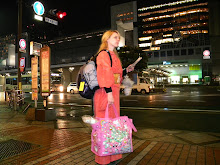
Monday, August 31, 2009

First Impressions of My New Life

[Actual Date: August 9, 2009]


FIRST IMPRESSIONS

LANGUAGE

I am somewhat of a disaster here. I don't know the proper way to speak, eat, or go anywhere by myself. I'm trying to learn the most significant words in the language, and the Korean phrase for “thank you" is endlessly useful. However, I pronounce every incarnation of the words slightly differently, so that sometimes the syllables come out in the wrong order or occasionally, I drop a syllable altogether. To compensate for these discrepancies, I mumble my “thank you's” and bob my head up and down several times in a frantic bow while simultaneously clasping my hands together in a prayer-like supposition, so that I must at least appear grateful if also, most unfortunately, a bit slow.

The other word I know is for my place of residence. When I'm out alone at night and decide to go home, I'll hop merrily into a cab and begin:

"Pook moon, poke moon, poke mun," I start to chant.

"Pook man, pokemon, pacman," I continue.

"Book man, backgammon, poke poke," I often finish in desperation.

Typically, between pokemon and pish posh, the cabbie will grunt and nod, satisfied that somewhere in the jumble of sounds, I've communicated a legitimate address.

FOOD

Eighty percent of the food I'm eating, I can't identify. The other 20% is rice. That being said, the food here is delicious. Except when it's inedible. A point in case would be the delicious-looking side dish that appeared on my table during my first dining experience. I used my chopsticks to spear, kabob-style, several large slices of succulent yellow pineapple, only to discover after cramming them into my mouth that they were really sour radishes. Yuck!

EATING OUT

At breakfast one morning, I must have been delirious with hunger, for I wandered down the street and into a small restaurant that was not only without any English menu, it had no menu of any sort. It also lacked the ubiquitous food photos that 95% of all restaurants here seem to include as a utilitarian part of their décor. The only form of menu appeared to be a few words of Hangul and prices written above the front counter. By the time I realized this, I'd already wandered to the back of the restaurant and the owner had come out to meet me and take my order. The only food item I can pronounce is “bulgogi,” which I know is not a breakfast food, so after desperately looking around the restaurant, I merely mimed the action of eating. The owner looked quizzically at me for a few seconds and then also mimed eating. Perhaps he was hungry as well.

This pantomime was followed by a staredown which lasted a good two minutes. Neither one of us blinked. Finally, the owner motioned for me to take off my shoes and sit on one of the cushions. I complied and arranged myself cross-legged at one of the low Korean tables. Within just a few minutes, the owner's wife presented me with a platter of food. Seven dishes in all, if you count the small side dishes. There was fish, rice, kimchi (which I routinely ignore), and the most delicious soup I've had since arriving in Korea, as well as four mystery dishes. As an aside, all of the food was delicious. The grand total for breakfast was about $4.

COMMUTE TO WORK

My second day in Seoul, I got lost on my way to work – in a forest. To fully appreciate the absurdity of this, you must remember that Seoul has a population of over 10 million people. It's hardly a rural environment.

My first day in Seoul, Jake drove me to work. That night, one of the teachers gave me directions for the quickest walking route to Yonsei. The teacher did not give me any street names, but that was only reasonable because most of Korea does not name streets. Not just no name in English. The streets have no names. At all. So, instead, I carefully wrote down, “turn right, walk uphill, take the staircase, turn right at the top of the stairs, turn left at the fork, etc.”

The next morning, I turned right out of my dorm and walked uphill. There were no stairs that I could immediately find, but after carefully scoping the area, I saw a rough-hewn staircase, assembled from large gray stones, leading up the mountain behind my dorm. Of course, that seemed like an odd path to work, but everything seems odd to me right now, I reasoned. So, I clambered up the stone staircases, passing by a tiny waterfall and an old man who was breaking stones just a few feet off the path. Eventually, the stone stairs led to wooden stairs which led to a dusty mountain path.

I climbed higher and further into the forest. After a short while, I saw Buddha. He was slightly larger than a life-sized man. His left hand was extended, thumb and middle finger lightly touching and his right hand raised, palm facing outward. Festooned on yards of string crisscrossing in front of the Buddha were bright-pink lanterns that looked like overgrown strawberries. “Curiouser and curiouser,” I thought as I continued down the path.

The path began diverging into different paths. I followed the directions I'd written down and trailed further and further into the forest. Occasionally, I ran across men with long trekking poles and women in walking shorts and visors. As it was my first full day at work, I was dressed in a floral skirt and was wearing lipstick pink pumps. I tried wedging the point of my heels into the dirt path for greater traction, my own mini-version of trekking poles. I saw no one who was American (judging by appearance), and I was too shy and frightened in a wordless, wandering manner to speak to any of the Koreans I encountered.

After about 40 minutes of trekking, I found my way to the edge of the forest and popped out onto a street – a real street with cars – but I did not know where I was, and in typical Korean fashion, the street was nameless. I saw a young Korean woman walking down the sidewalk. She was dressed in Western-style clothing and carrying an i-pod, so I hazarded a guess that she could speak English.

Not only could she speak English, but she was also a college student at Yonsei. She led me most of the way to the FLI and then pointed out the final street. It must have been out of her way for I saw her turning and going back the opposite direction after she'd safely deposited me.

CAMPUS LIFE

During the middle of my Yonsei University tour, Whitney pointed out a woodsy area that was filled with stone benches and well-spaced trees.

"This used to have a lot more trees," she stated in her typically serious manner, "but many of them were chopped down because so many couples use the area for kissing."

Whether she told me this as a fact, a suggestion, or a potential reprimand, I still cannot determine.

First Day in Seoul

[Actual Date: July 28, 2009]


Imagine this scenario:

A seedy-looking detective in a black-and-white, B-type movie shines a light in my face and sternly asks: "Where were you, Miss, on Sunday, July 26th?"

"Umm," I falter at telling the truth. "No where. I never had a July 26th this year."

I recently skipped a day in my life. Due to crossing the international dateline, it was as if Sunday, July 26, 2009 was entirely erased from my existence. Technically, I suppose I was sleeping on an airplane for that brief Sunday, but without memories, it feels as though it never existed.

The Saturday before, I arrived at the Chicago O'Hare Airport. It was 11:00 pm on Saturday, July 25 when I checked my luggage. My plane took flight two hours later, and landed in Incheon, Korea at 5:00 am Monday morning.

Despite the 14 hour non-stop flight, the plane ride itself wasn't too bad. The hardest part was actually getting on the plane. At the airport, I wanted to do nothing so much as go back to Ann Arbor, to my little slope-roofed attic room, my down comforter, my aggressively loving little cats. At the last moment, I wanted nothing more than to be drinking chicken soup and watching BBC movies at home on my computer. Going to the other end of the world without any friends of family or knowledge of the language suddenly sounded like insanity, a delirious idea originated by watching too many hours of the Travel Channel. But I made myself -- bullied myself, really -- into boarding the plane.

Once on board, I nestled into the curves of my seat and closed my eyes for the next several hours. Waking from a fitful slumber, I jerked open my window shade and looked down at a bright world. My body told me it was not the right time for day, but the sky outside had eerie edges of brightness to it, and far below me, I could see jagged little bits of light. Plumes of cloud drifted below the plane, and beneath them were islands dotting the deep sea. I could see a cluster of lights shimmering far away, in the netherworld beneath me. The plane's route was plotted on the screen attached to seat in front of mine, and because of that, I was able to identify our location. We were flying across the Bering Straights. It was magical.

After clearing customs and immigration, it was 6:00 am (Korean time) when I left the airport. Jake, a manager at work, picked me up at the airport and dropped me off at my dorm. I had two hours to unpack and eat and then it was off to work! That was a brutal surprise. I was so tired and disoriented that the room spun awkwardly every time I stood. My eyes could not focus properly. I staggered slightly when I walked. It was a bit like disembarking from the Tilt-a-Whirl after riding it 18 turns in a row. I was given lesson plans for the day -- 5 classes -- and began reading them during the school's opening ceremony where the teachers, including myself, were formally introduced to the students and their parents. I hadn't even finished reading all the lessons when I had to begin teaching them.

An important item of note: I'd never been informed I would be teaching. I was hired as a writing consultant for proofreading internet essays and dissertations. A second important note: I've never taught children. Dreadful, right? But the unexpected thing was that something inside of me sparked awake (probably a shot of adrenaline brought forth by panic) once I was in front of the kids, and I became my happy, lively self.

That night, I went out with the other summer camp teachers. We grilled our own beef, pork, and kimchi at a restaurant that had hot plates built into the tables (a current Korean dining trend). After that, we went out to the bars. All of us wore our pale yellow Yonsei uniforms; we looked like a bunch of Easter peeps. After that long plane ride, long day of unprepared teaching, and long night out, I didn't get back to the dorms until almost 3:00 am the following morning.

Reflections at the Embassy in Chicago

[Actual Date: July 21, 2009]

While I was waiting to pick up my visa at the Korean embassy, surrounded by a group of restless Americans in their twenties and thirties, I considered how many of us were going to Korea and how many were simply going from the U.S. I wondered if we are all running away, really, with our broken hearts, or even if we were simply running to escape the boredom that pairs with predictability: the tedium of life lived in a cubicle and “the inexorable dolor of pencils.” I wondered whether these people felt, as I do, divided by their choice to leave the country. It's the gravity of my predictable life in the U.S. that pulls me down – and not always in a bad way. It anchors me, gives me security to be surrounded by friends and to understand my own place in the order of things. And then there is this other feeling – this wanderlust – that draws me with its glittering possibility. What might be is the one unending phrase that always tugs along at my heartstrings.

It Takes a Village to Get Me to Seoul

[Actual Date: July 17-July 25, 2009]

I travel by serendipity, interspersed by occasional bouts of panic when my very loosely assembled plans fall through. It was in such a manner that I journeyed to Seoul.

My initial itinerary was to go from my parents' house in mid-Ohio up to Sandusky, OH, where I would meet my friend David and three of his friends who were all going to Ann Arbor for the weekend. Once in Ann Arbor, I would stay with a couple of other friends, Matt and Angie. While in Ann Arbor, I was then to meet my friend Brian, who had tentative plans for being in town that weekend and then driving back to Chicago. I would return to Chicago with him and stay for the few days it would take until I completed my visa interview at the “nearest Korean embassy,” and then I would take a flight from there to Seoul. Easy, right?

Of course, the best laid plans are reputed to fall apart, and these weren't the best laid plans by any means, but merely an A to B to C to D itinerary I'd constructed within a few minutes. I managed to get to Ann Arbor and spent the weekend dancing and chatting with friends, but then became somewhat trapped there when my Chicagoan friend got called out of town by his work. I then was left without a ride to Chicago and without a place to stay. In addition to these handicaps, I also had in my possession a strong contender for entering the Guinness Book as the world's heaviest collection of suitcases. The second biggest one was so heavy that I could only move it by kicking it. In order to move my largest suitcase, which was monster-sized,* I resorted to staring dejectedly at the bag and then looking pointedly at the strongest of my male friends.

Before panic at my dilemma had completely overwhelmed me, I mentioned the situation to one of my Ohioan friends, Neil, who introduced me to Kristine, his girlfriend, who lives in Chicago. Kristine and her friend Emily included me in their carpool from Ann Arbor to Chicago. On that same Sunday morning, I made a phone call to my cousin D., who let me into her downtown apartment later that night and welcomed me to stay until my plane left Chicago six days later.

It is only with the greatest restraint that I refrain from using the adjectives wonderful, gracious, and amazing at every mention of all these people. I'm typing this blog entry on my desk in Seoul, where I arrived safely in large part due to the help and kindness of warm-hearted people and dear friends.


*comfortably fits a small to medium-sized ogre

The Blog Is Back!

Due to circumstantial problems, such as failed internet connection, a missing adaptor cord, and sloth, I've not yet posted anything about my first month of living in South Korea. That will soon change. The next several posts will be adaptations of my diary from the month of August. Stay tuned later for this week for the next thrilling installment of Odysseus Drifts.

Wednesday, July 15, 2009

Two Lemons and An Orange: Melanie's Packing List


Airline luggage policy asserts that two refrigerator boxes packed with clothes and then duct-taped shut are not acceptable substitutes to be checked in lieu of two suitcases. And don't even bother asking a flight attendant if one of the fridge boxes can be substituted for a carry-on.


The problem with packing in anticipation of two years spent outside your own country is that two years' worth of items do not fit in two suitcases. When first preparing for this trip, I packed like a typical traveler. That is to say, I laid out all the necessities and lined them up so that one bag could be filled with useful items, such as soap and shoes, and the other filled with clothing that could cover weather spanning four distinctly different seasons. After the bag was so full it strained at every seam, I then climbed on top of it, and bearing down, with sweat pouring from my face and while shouting derogatory remarks about airline luggage restrictions, I closed and zipped the case. I followed this exact procedure for each of my suitcases and I highly recommend it for fellow travelers.


The real issue is that, for undoubtedly the first time in my life, my packing has taken place several days in advance of my actual departure. My typical packing method is to open a bag, toss in whatever strikes my fancy at the moment, and then rush out the door with a good five minutes to spare before the: a. plane takes off, b. train leaves the station, or c. bus departs from the terminal. Then when I arrive at my destination, I open my bag with the same giddy anticipation in which one opens a grab bag from the carnival. I have, in the past, managed to pack five pairs of pants but no underwear, or three books of poetry – to a dance event – but no water bottle and no dance shoes. The overall convenience of grab bag packing leaves something to be desired, but the element of surprise never fails to amuse.


My current situation, as mentioned previously, has left me with far too much time on my hands after packing my bags. For the past few days, I've been noticing the things that have not been packed, such as a set of golf clubs, a thigh master, the annotated, unabridged edition of Shakespeare's collected works, or some other equally unwieldy and improbable item, and, given the time for reflection, I've often come to the realization that said item is imperative to my daily lifestyle. And so, on more than one occasion, I've unzipped a quarter-sized gap in the suitcase (any larger opening would result in all the contents spilling out) and maneuvered a lacrosse stick or whatever into the aforementioned tiny opening while simultaneously shimmying the suitcase until the item became nicely wedged into a bag that was, to all appearances, already full.


My only rule of packing is: Items packed in suitcase shall remain in suitcase. I have come to the bitter realization that my work wardrobe for Seoul thus includes three pairs of black dress pants, two black skirts, innumerable black tops, and one navy blue pair of loafers. Never mind that an identical pair of dress shoes in black sits at the front of my closet. The navy pair have been packed, and so my fashion fate is duly sealed.


Even given the amount of time dedicated to my recent packing session, I cannot remember everything I included in my suitcases. What will emerge during the customs search at the Incheon airport or later as I settle in my dorm room? What will my suitcases deliver? It's a slot machine; it's a gamble. All I can do is stare wistfully at the bulging sides of my bags and whisper, “Come on, baby. Mama needs a new pair of shoes.”

Friday, July 3, 2009

How I Got Here

In October, I reached the half-way mark in my savings for a backpacking trip around the world. It was also in October that my favorite cat, Baci, was dying. He'd apparently been starving himself and his liver was severely damaged, but it wasn't until one Sunday night when he curled up next to me in a strange, almost-woozy manner that I noticed something was wrong. To rouse him, I poured some fresh cat food in his bowl. He wouldn't eat it. I scattered some treats in front of him, but he wouldn't eat those, either. When I broiled a salmon and placed it before him, he didn't even sniff the plate. He just laid his head in my lap and emitted a soft purr.


The vet confirmed my fears when I brought him to the animal hospital the following morning. Baci was taken from me and hooked up to several intravenous tubes for hydration and medicine. It wasn't good, the veterinarian told me. If he was still alive after a couple of days, they would need to perform an esophagostomy. It was an expensive operation that, given his current condition, would give him a 50% chance of survival. He would also need to remain in the hospital, with staff administering medicine and monitoring his health periodically through both the day and the night. There were also referrals to another pet clinic, in order to properly diagnose the underlying root of the starvation Baci had imposed on himself. All in all, it would cost 50% of the money I'd taken two years to save, and it would only give Baci a 50% chance of living through it.


For those of you who are wondering the magic it takes to save $10,000 in two years when working for a very modest salary, I am divulging my money-making secrets right here: I worked. Incessantly. My jobs were all low-paying, but I had a variety of them, sometimes working as many as three jobs simultaneously, which meant my typical work week (for the first year) was 60-80 hours. During the majority of that time period, my steady job was as an online editor of secret shopper surveys, which made it easy to incorporate a variety of alternate jobs into my schedule: scoring standardized tests, selling bookbinding supplies, directing cars and selling cooleroos at the Ann Arbor Art Fair, making beaded eyeglass holders at a rock shop, writing recommendation letters and college entrance essays for rich-but-dumb students, and finally, purchasing and negotiating for a leading automotive company. In addition to my heavy work load, I lived like a poor person. I didn't go to movie theaters. I didn't buy new clothes. I didn't eat out in restaurants. Instead of buying a car, I either walked or rode the bus. The last job I held was in a different city from where I lived. After riding the bus 45 minutes to the closest stop, there were still two miles left between me and company headquarters. I'd ride my bike, The Nevermind, or walk those last two miles. "What do you do when it rains?" a co-worker once asked. "I get wet," I replied, which served as both a punchline and the uncomfortable truth. After biking through one particularly vicious rain storm, I arrived at work so drenched and disheveled that I simply told people I'd swum over from the Titanic. Obviously, when so much hard work and sacrifice went into saving my money, it was not sensible for me to throw it away on a hopeless cause. And it wasn't just money, just savings in the bank; it was my dream. It was my ticket for traveling around the world.


When I adopted Baci from a rescue group, he was only a few weeks old and so tiny he fit in the palm of my hand. At night, I'd fall asleep with Baci at my feet, and in the morning, I'd wake up with him on my pillow. His idiosyncrasies included a predilection for keeping two catnip snakes, his favorite toys, in the food bowl. He was afraid of bubbles, the vacuum cleaner, and sometimes ants. Whenever I called for Baci, he came. Sometimes he ran eagerly; sometimes he slunk forward in a sulky manner, but he always came to me, perhaps not realizing that, as a cat, he could have ignored me and still met status quo. If I'd made a pros and cons list regarding whether or not to spend thousands of dollars on Baci, I could have come up with a dozen reasons to put my cat to sleep and save my money. Even if I spent everything on him, there was only a half chance he'd be saved. There was only one reason I had to sacrifice my dream: I loved him. “Do whatever it takes,” I told the veterinarian.


As a child, I was always trying to save creatures smaller than myself – birds that had fallen out of their nests, rabbits that had been ravaged by neighborhood cats, a Canadian goose that was drowning, a puppy running down a busy highway. My mother always tells the story of how, as a toddler, I tried to save a cartoon animal falling off a cliff by running up to the TV and holding my hands against the screen. I'd essentially been training for an animal nursing marathon since I was a child. Baci made it through the operation and stayed in the animal hospital a week longer, but he was still in danger. The only way he could receive nourishment and hydration was through his feeding tube and the administration of subcutaneous fluids. When I took him home, it was my job to feed him through the tube 6 times a day. Given the fact that my work and commute took about 10 hours of my day, and I needed to prepare the tubes before feeding Baci – puree and heat the food, fill the syringes and tap out the air bubbles – it meant I had to feed him roughly every 2 ½ hours throughout the evening and entire night. Then I'd leave for work early in the morning and work through the day. My life was spent as though in a delirium. I was never fully awake and never fully asleep. This lasted over two months. It also included uncertainty and the fear of losing him. I would leave the room and be afraid to return, afraid of the silence, afraid that if his body was still, it meant he was no longer breathing.


Whenever I fed Baci, I'd lift his emaciated body onto my lap and sing to him, sweet little nonsense songs. And I'd pray for him, more than I've ever prayed for anything. I asked anyone I came across to also pray for him. Every breath Baci took was a miracle, every mm of food his body accepted was a prayer answered. I explained my devotion to my cat by telling people I loved Baci like he was my child. But that wasn't it, not really. I didn't love Baci like a child or a best friend or a cat, though, at times, he filled all those positions. I simply loved him. I knew that, as far as he was capable, Baci would have done anything for me. I owed him no less.


By the first of January, an auspicious new start to the year, Baci ate entirely on his own. I stopped feeding him through the tube and almost a week later, the veterinarian removed it. Provided Baci takes daily medicine for his liver, the vet says he should now have the longevity of a normal cat. I feel blessed by this, and I've never regretted any of the sacrifices I'd made. But along with my joy at his recovery, a resigned melancholy set in place. I'd given up on my dreams. I no longer tried to scrimp and save my money for rtw travel because it no longer seemed possible. All I'd previously denied, I now gave to myself in spades. I bought clothing with Labels and wore them to movies, concerts, and out-of-town dances. I hung out with friends and didn't calculate the cost beforehand. In some ways, it was the Fabulous Life. In another way, though, I knew I was spending money because I felt defeated. I'd worked so hard for my money and denied myself so much pleasure, and nearly half of it was gone in less than a month.


My epiphany arrived at work one day in the form of the company secretary. I have the suspicion my colleagues at work, which was, in all fairness, an automotive company, gossiped among themselves as to why I refused to buy or lease a car. “I'm saving my money,” was the only reason I would laconically offer. “I know why you're saving your money,” J. told me one day, leaning across my desk in a conspiratorial manner. “You want to teach English abroad, right? You're saving up to move to Korea, where the teachers earn high salaries.” “No, that's not it,” I said. “I could do that right now if I wanted.” And then the heavens opened, a flock of doves descended, and a great, transcendent, incandescent light bulb lit directly above my head. “I can do that right now,” I repeated to myself in thought. And so, that's exactly what I'm doing. For the next year, I'll be experiencing the Korean lifestyle, food, and culture while saving the money necessary to continue traveling around the world.