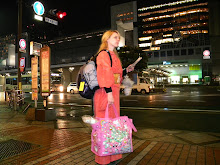
Two days after my birthday is nearly my deathday. I do not recognize it as such that morning, of course, unrolling myself from the floor, stretching awake, and then bounding off to work. I do not realize it as I go to a blues dance at Swing Zoo that night, at the time my only concern being the brief, dark walk from the dance club to Sindaebang station, and I do not realize it as I walk though my neighborhood, by chance running into a friendly group of Happy Bar dancers who then invite me to go out drinking with them. My day is normal, joyful even. Then I return to my home.
As always, my neighbors have left the main door of the building not only unlocked, but swung wide open into the street. I climb my stairs without a second thought about it. This is Korea. It is always safe here.
I can not immediately fall asleep after a night out, too wound up, mind and body still active from the long day. I turn on all the lights in my tiny apartment, grab a book, and prop myself up against the kitchen wall. About 20 minutes into reading, I hear the noise of footsteps on the rooftop. Well, I think to myself, it's not just my rooftop. Maybe the neighbors just came up to get a bit of night air. The footsteps do not leave; instead, they seem pacing in front of my apartment. Or maybe, I think to myself uneasily, they just need to hang up some washing? The clothesline is just in front of my place. Laundry at 3:00 a.m.?
Then I see it, just slightly, the handle of my locked door quivers as someone tests its give. I take my fist and pound against my side of the door. Footsteps fall back loudly in surprise.
I stay next to my door, and tensely continue to read, waiting for I don't know what. About 20 minutes later, I hear the thin metallic ping of my door as the handle is moved once more. The light outside my door flickers on and off, triggered by movement.
Perhaps it was not meant to be my deathday. Perhaps that is an exaggeration. All I know is that the lights in my apartment are bright, and there are no curtains. The only things visible through the window of my apartment are my refrigerator and a pile of dirty clothes. I don't even have any furniture, besides the fridge. The only thing of value in the apartment is . . . me.
As difficult as it feels to immerse myself completely in darkness, I turn out all of my lights. Since I had spent so much time in the windowless kitchen, it is possible the intruder has not actually seen me. I do not want him to know I am a woman. I do not want him to know I am a foreigner. I do not want him to know I am alone. With all the lights out, he should be blind to me. I creep to the window in my living room, peer from the edge. I can't see anybody, just the motion light sensor as it again flickers on and then off.
I crawl over to the last "room" of my apartment, which in essence is an open closet. It is where I've stacked my piles of clothes and books, still unsorted after my recent move. The closet room has only a thin curtain -- a starry, magenta scarf, partioning it and the rest of the room. During the previous night's thunderstorm, I had dragged the foam mattress topper and pile of blankets that serve as my bed into the closet, in order to better avoid the lightning. I crawl to it now, my body slunk into the ground in an effort to escape the intruder's attention. As I blindly crawl, I put my hands out to either side of me, feeling the ground. My phone! Where's my phone? I can't find my phone.
Then I realize. I have not paid my phone bill this month. I cannot dial out. What's more, I don't even know my own address.
I reach the closet, grab my largest umbrella and lay it beside me. It is my only possible weapon.
About the same time, at what I guess to be two or three buildings away, a woman starts screaming. These do not sound like ordinary screams, but more like a keening wail that rises and falls in grief. The woman screams and screams. She does not stop screaming.
I hunker down into my pile of blankets. Willing my body to be smaller, unreachable, I curl into a tight little ball. I say a prayer. Amazingly, within minutes, I fall into a deep, dreamless sleep.
Unbeknownst to me, the outside screen of my window silently slides open.
It is Friday the 13th.
This is not fiction.
This is not a dream.
This is my life.
Saturday, August 14, 2010


Wednesday, July 21, 2010
Boryeong: It's the Journey, Not the . . . You Know

Since Joseph had plans for soon selling his motorcycle and leaving the country, he was quite keen on taking his bike for a road trip to the Boryeong Mud Festival. I also wanted to go to Boryeong. I was not, however, so keen on the prospect of motorcycling there. I shovelled pho and crisp bean sprouts in my mouth over a late breakfast and worried aloud about falling off the bike and meeting an untimely demise.
Do you realize that my mother will kill me if I die on a motorcycle? I asked him. No, I amended, my mother will kill you if I die on the motorcycle.
Joseph didn't appear overly concerned about either of our imminent deaths and even seemed quite confident I would not fall off the bike, stating that it simply was not possible unless I physically pushed myself off it. I, however, more fully realizing the range to which my clumbsiness can extend, had visions of myself lying mangled on the side of the road and looking up at Joseph, using my last gasps of breath to form those four little words that everyone loves to say but hates to hear: I. Told. You. So.
Part of the journey to Boryeong, which lay on the southeast coast of Korea, was through crowded cities, where Joseph would weave the bike through gridlocks of cars before stoplights, like a game of vehicular tetrus. In between the cities were, inevitably, highways and freeways through the country. Flying down the long, empty stretches of freeway terrified me, and at those times, I clung to my poor friend.
I don't understand it, Joseph said. When we're going through the city streets and massive waves of cars are unpredictably changing lanes at the same time, you don't bat an eye, but when we go 90 km an hour down a clear country road, you cling to me.

My hold on the bike, or rather, its driver, depended entirely on my level of fear at any particular moment. If I was relaxed, my hands would rest loosely by his sides; if I was scared, they would be wrapped tightly around his waist. My riding style was less that of a Hell's Angel and more that of a barnacle.
We passed by lovely, but largely unchanging, scenery. Korea is filled with clusters of mountains, in rich, earthy shades of emerald and jade. The countryside is also full of rice paddies, where the plants are arranged into perfectly-formed rows inside neat squares. I watched the silky, bright green rice plants ripple in the wind as we flew past them.
At one point, our road ran parallel to a train track that had a train steaming down it. We went faster and faster, first gaining, and then beating the train's pace. Do not race the train, I told Joseph. But I did not tell him that until after we'd come to a stoplight, after we'd "won" the game as far as we could play it. Secretly, I liked racing the train. I was terrified, yes, but also exhilarated.
We took the motorcycle from Seoul to Boryeong with the vague idea that the trip would take us 2 or 3 hours. It took us 6 hours, but finally, we arrived. After locating the festival grounds, we parked the bike, passed under the cartoonish arches, and discovered -- that the mud was closed.
How is this possible? I wondered outloud. How can anyone possibly close mud? It's just . . . mud. It's inconceivable!
I do not think that word means what you think it means,* Joseph responded as we looked about at the dismal, now empty mud pits and the few dirty stragglers who had apparently made it to the festival in time but had not yet left.
What do we do? we asked each other, and quickly determined swimming was the penultimate option. The ocean was only a few feet from the festival grounds, and aside from a wash of mismatched flip-flops and empty soju bottles left by careless mudfest revelers, it looked like it would make for a nice swim.
Nobody else is swimming, Joseph observed. That's so lame.
We waded about 5 feet off the shore and then heard loud whistles and the orange-suited Boryeong policeman, who were patrolling the sands, sternly waved us back to shore.

The ocean was closed as well. It's a wonder they don't try to turn off the sun, I thought to myself.
Wandering around the festival area, we found a partially-deflated rubber pit that still had about 3 inches of mud in the bottom.
Well, said Joseph reflectively, I've always wanted to lie in a big pool of mud.
So we laid back in it, looking up at the bright blue sky streaked with wispy white clouds. It was surprisingly peaceful. And predictably gross.
I began laughing. When Joseph asked why, I tried to explain. This whole trip. Us. We could be an indie movie right now, having spent 6 hours on a motorcycle to miss the festival and end up laying in a deflated pit of mud.
You don't understand, Joseph replied. This is my life.

We left the pit with the grey clay mud painted across our legs and backs, indiscriminately streaked across our faces, and clumped into locks of our hair in true rastafarian style. We walked to the edge of the ocean and looked into its forbidden blue expanse, the curling white-tipped waves rushing toward us.
You know, said Joseph, I reckon it will take them at least 30 seconds to pull us out from the water. Are you ready to run? On the count of three: One, two, three . . .

---------------------------------------------------------------------------------
*Lies: Our actual dialogue did not quote The Princess Bride, but a transcript of the entire 10 minute conversation pondering why/where/how all the mud had disappeared is just tedious. All other dialogue is more or less accurate.
Wednesday, July 14, 2010
Eumseong Pumba Festival

In mid-June, I decided that going to the Pumba ("Pretend Beggar") Festival in Eumseong would be just the ticket. What made me decide on this, out of all the festivals Korea has to offer? Absolutely no reason! I did, however, convince a small group of friends to come along, and they're what made the trip fun.

We started out the morning by meeting at the bus station 15-20 minutes later than we'd all previously agreed. Every one of us was late, so much so that I began to laugh out loud on the subway while getting a series of apologetic texts from my friends. We are all lindy hoppers, though, and had spent Friday night dancing at various different venues around Seoul. It was really unreasonable to expect any of us to be punctual the next morning.
Maybe this lack of sleep is how we agreed, after finally making it to the festival, that silkworm larvae would make the perfect breakfast. We yawned; we stretched; we ate larvae.

It did wake some of us.

Perfect for both foreigners and children, the play did not use any spoken language; it instead relied upon colourful costumes, music, and players who engaged in a lot of physical activity.
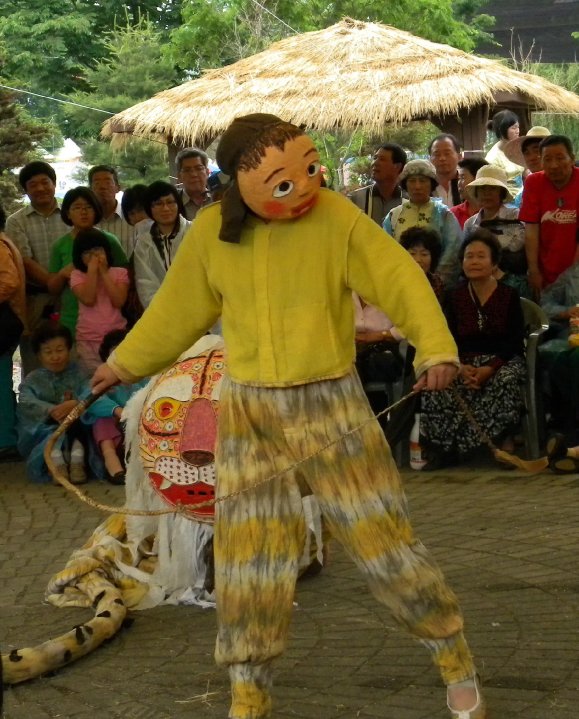
Well, the lion baby did yell "Omma!" when she kicked her legs and threw a tantrum, but we could all easily figure out this meant "Mama!"


The local public restrooms never had any toilet paper. We did, however, see this guy perform. Just where did he get his costume? Looks sus to me . . .

While at the festival, we saw a little open-air bus, which was actually more like a glorified golf cart. It stopped where we were standing, so we bounded onboard. It drove us around in a circle and deposited us back at the festival's entrance, all the while playing 70s era music.
 ("And it arrived out of nowhere, just like a gift from the disco gods." ~ Eimir)
There were three living statues near the festival's entrance. They wore robes in bright gold or green and had their faces painted to match. These performers posed while standing on wooden stools. Their long robes covered the stools and pooled onto the walkway beneath them, thus giving the statues the illusion of height.

While I was taking a photo of the statues, some random festival photographers decided it would be a swell idea to photograph me with the statue. Joseph offered to hold my bag, but the photographers saw this as a two-for-one foreigner deal, so he got placed in the photo, too. Blue eyes = B-list celebritydom in Asia.
 (photo credit: Eimir)
To end our day, we took the bus back to Seoul and saw the very first World Cup game with Korea (Korea vs. Greece) on a giant TV outside the Coex Mall. Millions of Koreans were watching the game on giant TV screens embedded in skyscrapers throughout the city, though the crowds were slightly less than anticipated due to a steady drizzle.
Here are hundreds of excited World Cup Korea fans watching a screen filled with hundreds of other excited World Cup Korea fans. It's meta-spectatorship!

Joseph, Katie, and I assimilate to the local culture.

And for the perfect day's ending, Korea won the game.
Flashback to Japan

Want to learn about my winter vacation in Japan? I've written a brand-new entry about it, but post-blogged it in the February 16 slot. This new (though post-dated) entry contains information you can glean for your own vacation to Hokkaido, such as:
1. When to lie about your nationality.
2. How to stay a week for free with strangers you've met through the Internet.
3. How to ask directions from a pimp.
All these -- and more! -- are covered in my informative, narrative-style guide. Scroll back to February 16 now for your learning pleasure.
Tuesday, June 1, 2010
Lighting the Lotus Lanterns

I did not want to see the Lotus Lantern parade. Or, to be more precise, I very much wanted to see the Lotus Lantern parade; I just didn't want to see it by myself. Nonetheless, the weekend before Buddha's birthday, the day when all of Korea stirs the land in celebration, I found myself very much alone.
I spent the morning fidgeting in my dorm room. Then I spent the afternoon fidgeting through the aisles of overpriced goods at the Hyundai Dept. Store. After I had finished spending a large portion of my day doing nothing particularly useful, I forced myself onto a packed subway train, finally tumbling off at the Insadong stop with hundreds of other Koreans, all of whom seemed to arrive in large groups of family members and friends.

Exiting the subway, I quickly and instinctively walked to Jogyesa Temple. I was uncertain exactly where Buddha's birthday celebration was to be held, but Seoul's main Buddhist temple, housing three resplendently large, gilded Buddhas, seemed a likely starting point for my quest. The temple was busy -- packed with people -- just like the subway and surrounding streets. As I was to later find out, there were thousands of people both as spectators and participants in the parade. I took out my camera and took exactly two shots of the temple, which had a rainbow of paper lanterns hooked to wires above it, when I thought I heard my name.
But that couldn't be. I didn't know anyone who was coming here. I ignored what I assumed to be the voice of my overactive imaginatio and took a third photo, when I heard my name shouted more loudly. And there they were: Jeff, BB, and Goan,* three swing dancers I knew slightly from the local dances. After speaking a few minutes, they kindly invited me to drink makoli with them. So, we found a quiet corner of park just outside the temple (no drinking on temple grounds) and had a picnic of Korean pancake, gimbap, fried mandu, and makoli.

During the picnic, we were joined by two other dancers, Robin and his fiance Yeoni.* Soon after the picnic, we heard a clanging of drums and bleating of horns from the street outside the temple. We rushed to the street and saw the start of the parade. Row upon row of lantern bearers passed. They were dressed differently according to their group's affiliation, and also carrying lanterns in different shapes and colours. Women were dressed in hanboks luminescently pearl-sheened, green, white, rose-petal pink, fushia . . . every colour imaginable . . . and the lanterns they lifted on poles above them were fish-shaped, bell-shaped, square-shaped, sock-shaped, etc. There were even a group of brown-garbed monks with shaven heads, carrying lanterns in both their hands -- lanterns that were russet-coloured and shaped like alms bowls.


As the parade progressed, the lanterns became increasingly large and elaborate. They moved from small ones held by individuals to giant lanterns on floats that were carried by four to six men, and even floats that had engines attached to them. A variety of giant Buddhas and giant lotuses were to be expected, but there were also a large number of tigers, white elephants, scenes from traditional Korean lore, and -- my favourite -- fire-breathing paper dragons!

It is my personal belief that more public events should include random bursts of contained fire. Even the stage performances we watched after the parade had several columns of fire shoot up from the edge of the elevated platform. At the parade's conclusion, after several hours of watching what seemed a never-ending multitude of almost-magical lanterns, millions of pink petals were released from the sky. They floated down among us and we leapt up to catch them in our hands.

*Some of the names have been changed to protect those** who can't spell.
**Myself.
Sunday, May 30, 2010
Small Girl, Great Wall

I grew up in a small town in Ohio. Not even a town, technically, as the population density, or lack thereof, classifies it as a village. Even other Ohioans are rarely aware of Greenwich Village, and when asked to further clarify its location, and my origin, I often jokingly claim that I was raised in the middle of a cornfield. Greenwich (pronounced "green witch" -- we're a phonetic people) had the advantage of being one of the safest places on earth for a child to be raised, and I'd often play barefoot in the soft, uncut grass of my backyard or even in my neighbors' backyards. In the purpley-grey dusk of evening, my best friend and I would coast through town on our bikes, sometimes playing an elaborate game of hide-and-seek throughout the village. It didn't really matter where I roamed; as Greenwich was too small for any sense of anonymity, everyone knew either me or my parents.

Nonetheless, there were disadvantages to living in such a small town. I felt certain limitations without fully being able to understand or express them. My dreams of becoming an author or an artist, and my accompanying individualistic attitude, marked me as a shy eccentric. When Disney's Beauty and the Beast was released, I could relate closely to Belle, who dreamily lamented, "There must be more than this provincial life," while her neighbors, not unkindly, sung, "It's a pity and a sin / that she doesn't quite fit in."

Books were my escape. There was the library, which though now moved to its own separate building, was once located in a single, corridor-like room on the second floor of the firehouse. I would visit the library/firehouse and pile books pecariously on the handlebars of my pink 10-speed bike to transport them back to my house. My favorite books included an enormous tome of Tennyson's collected works. It had a dark, satiny, mustard-coloured cover, gilt edging, and original engravings from the 1880s, when the book was published. I also liked to tote back what few travel books our library proffered, which were fortunately kept a bit more up-to-date than the poetry section. After making it home, I would spread these out, with my geography book from school, along the honey-coloured wooden floorboards of my bedroom and read bits of everything. Too greedy for information of a bigger world, I'd sometimes try to absorb them all at once -- soothing, rhythmic sections of The Lady of Shallot, snippets from travel guides, photos from my geography book . . . especially photos from my geography book, poring over scenes of the Taj Mahal, the Parthenon, the Pyramids, the Great Wall of China, wishing that I could see such places in person but never considering it an actual possibility.

When I was in China, I visited the Great Wall, not once, but twice, hiking along different sections both at Mutianyu, a restored Ming dynasty area only an hour outside of Beijing, and at Shanhaiguan, where the Great Wall snakes into the Bohai Sea. While I was there, I felt something expand inside me: a sense of achievement, of somehow entering the geography books myself. That's a lot of what this blog is about for me -- a celebration of the fact that one day, I only dreamed of seeing the world, and now it's really happening.


Friday, April 30, 2010
Night Train to Xi'an

During the train ride to Xi'an, I knew exactly three and a half words of Chinese: nee-how (hello), shah-shah (thank you), ping-my-o (terra cotta warriors), and jiao (the last syllable for "dumplings").
The train ride in itself was an adventure. With a small red square of a ticket clutched in my hand, I boarded what I could only hope to be the correct train in Beijing's overwhelmingly large train station. In fact, the number of people milling about the station on an average weekday was likely three times the size of the entire population the small Ohio town in which I had been raised.
I had been advised to take a first class sleeper, which was touted as being more comfortable and generally filled by high-class Chinese business men and other foreign tourists like myself. Whether or not the amenities of first class were as luxurious as promised and the people as genteel I could not say, for in my possession was the ticket for only a hard berth, second class sleeper -- which was half the price, as well as being the only option available for purchase on the same day as I left.
I located my bunk and sat nervously (and uncomfortably) at the edge of the bed, putting the kilo of bright red wax berries I'd bought earlier that day on the bed beside me. I didn't have any specific anticipation for what a second class sleeper should entail, but they were as follows: The "rooms" without doors, just a tight pile of 6 berths (three on either side of the area) with a table and trash bin in between. There were also a number of tiny table ledges with fold-down chairs by the train windows. A number of Chinese men were already sitting at the tiny tables, smoking, chatting, and reading local newspapers. It may have been my imagination, or perhaps some combination of hypersensitivity and egoism that colors my observation, but it seemed that everyone stopped their activities, for at least the first few minutes after I made my entrance into the train car, and stared at me.
A young Chinese couple sat on the bunk across from me. We stared at each other inquisitively for a few minutes, and then I asked if they could speak English. "Yes," the young man tentatively replied, "a little." Later, I would learn his name was named Lintao, which means "wind moving through the forest."
"Hello," the girl said, in a prim though not unfriendly manner -- rather, as though repeating a dialogue learned in school -- "How are you?"
"I'm scared," I confessed. "I've never ridden by myself on an overnight train."
Whatever barriers are naturally kept between strangers then seemed to melt.
"It's ok," she said, smiling.

The young man and woman were then joined by another traveling companion, a second young man. We all shyly spoke to each other, opening up more as the train rumbled down its track. They were all from the same company, working as engineers and IT personnel in Beijing and being sent to Mongolia on an assignment. They would be on the train for 33 hours, as compared to my journey of 12 hours. We didn't do anything so exceptional on that trip, but it was nonetheless a little wonderful: We played cards (Lintao helping me with my hand, so that I could learn the game's rules by observation, which I partially, but never fully understood), they spoke to me of American sports (which the Chinese men understood far more fully than myself), I asked which cities in China were the best to visit and they took the Asian map I had with me and circled all their favorite cities, writing in the names of a few places that weren't on the map.
At one point in the night, I noticed my red waxberries had puddled out the corners of their plastic bag and leaked onto the bedsheets, a large cerise halo staining the formerly pristine linen. When the train matron discovered what happened, she yelled in a general sort of way, but I could see that she was secretly amused by the incidence, as were all my fellow passengers. After that, I shared out the waxberries with my new friends and we ate them until our fingers and mouths were stained vermillion.
When I finally bundled down to sleep a not-at-all-inconspicuous crowd of Chinese men gathered at the table nearest the foot of my bed, watching me. I am uncertain what they could have possibly gained by the spectacle of me tossing about on the bunk until my bed clothes twisted round my body like a winding sheet. Their observations could have led to nothing more profound than: Western lady finds it difficult to sleep on a hard bunk. Or the more astute may have concluded: Western lady finds it difficult to sleep on a hard bunk while five strange men are watching her.
Which brings me to the next morning. . . As I left the train station early in the golden softness of an April dawn in Eastern China, I knew exactly three words in Chinese. (I had forgotten the last half of the word for dumplings sometime in the middle of the night.) I had also, most unfortunately, lost the tiny scrap of paper -- really, a hostel advertisement -- that served as a map for Xi'an. So, I had no city map, no guidebook, no friends at that point, and only a vague idea that the terra cotta warriors were NOT AT ALL near the station. All of this would be easily enough to overcome if I would simply relent and use a taxi like other Western tourists. But, in the words belted out by Tina Turner, "[I] never, ever do things nice and easy."
I bounded up to a woman who was working at the train station. "Ping-my-oh?" I asked. She waved me to the left. I didn't really see any place to the left with the appropriate bus, so I then bounced up to the another woman who seemed local to the area. "Ping-my-oh?" The lady took me by the hand and led me to wait at an underpass where dozens of other Chinese people were also waiting, patchwork suitcases and bags of food in hand. The problem was that this area was also not a bus stop. After waiting for about 15 minutes, I approached a young, college-age man. "Ping-my-oh?," I inquired hopefully. The young man looked horrified. "No, no, no!" and he took his bag and scampered away. Hmm. Maybe I'd used the wrong intonation. I tried another woman, this time virtually cooing "ping-my-oh" to make it sound harmless as a baby. She did not know, either, but eventually located a Russian woman who gave me perfect directions to the correct bus stop.
Finally, I boarded a bus with a group of middle-aged Chinese people, most apparently on their way to work. In contrast to their bland facial expressions and serious work attire, loudspeakers filled the bus with excessively loud American club music. A dozen stops, a few dollars, and about 40 minutes later, and I arrived at the gate to one of the world's greatest historic and artistic discoveries, the beautifully detailed terra cotta warriors, the elusive ping-my-oh.


Subscribe to:
Posts (Atom)