Friday, April 30, 2010

Night Train to Xi'an


During the train ride to Xi'an, I knew exactly three and a half words of Chinese: nee-how (hello), shah-shah (thank you), ping-my-o (terra cotta warriors), and jiao (the last syllable for "dumplings").

The train ride in itself was an adventure. With a small red square of a ticket clutched in my hand, I boarded what I could only hope to be the correct train in Beijing's overwhelmingly large train station. In fact, the number of people milling about the station on an average weekday was likely three times the size of the entire population the small Ohio town in which I had been raised.

I had been advised to take a first class sleeper, which was touted as being more comfortable and generally filled by high-class Chinese business men and other foreign tourists like myself. Whether or not the amenities of first class were as luxurious as promised and the people as genteel I could not say, for in my possession was the ticket for only a hard berth, second class sleeper -- which was half the price, as well as being the only option available for purchase on the same day as I left.

I located my bunk and sat nervously (and uncomfortably) at the edge of the bed, putting the kilo of bright red wax berries I'd bought earlier that day on the bed beside me. I didn't have any specific anticipation for what a second class sleeper should entail, but they were as follows: The "rooms" without doors, just a tight pile of 6 berths (three on either side of the area) with a table and trash bin in between. There were also a number of tiny table ledges with fold-down chairs by the train windows. A number of Chinese men were already sitting at the tiny tables, smoking, chatting, and reading local newspapers. It may have been my imagination, or perhaps some combination of hypersensitivity and egoism that colors my observation, but it seemed that everyone stopped their activities, for at least the first few minutes after I made my entrance into the train car, and stared at me.

A young Chinese couple sat on the bunk across from me. We stared at each other inquisitively for a few minutes, and then I asked if they could speak English. "Yes," the young man tentatively replied, "a little." Later, I would learn his name was named Lintao, which means "wind moving through the forest."

"Hello," the girl said, in a prim though not unfriendly manner -- rather, as though repeating a dialogue learned in school -- "How are you?"

"I'm scared," I confessed. "I've never ridden by myself on an overnight train."

Whatever barriers are naturally kept between strangers then seemed to melt.

"It's ok," she said, smiling.


The young man and woman were then joined by another traveling companion, a second young man. We all shyly spoke to each other, opening up more as the train rumbled down its track. They were all from the same company, working as engineers and IT personnel in Beijing and being sent to Mongolia on an assignment. They would be on the train for 33 hours, as compared to my journey of 12 hours. We didn't do anything so exceptional on that trip, but it was nonetheless a little wonderful: We played cards (Lintao helping me with my hand, so that I could learn the game's rules by observation, which I partially, but never fully understood), they spoke to me of American sports (which the Chinese men understood far more fully than myself), I asked which cities in China were the best to visit and they took the Asian map I had with me and circled all their favorite cities, writing in the names of a few places that weren't on the map.

At one point in the night, I noticed my red waxberries had puddled out the corners of their plastic bag and leaked onto the bedsheets, a large cerise halo staining the formerly pristine linen. When the train matron discovered what happened, she yelled in a general sort of way, but I could see that she was secretly amused by the incidence, as were all my fellow passengers. After that, I shared out the waxberries with my new friends and we ate them until our fingers and mouths were stained vermillion.

When I finally bundled down to sleep a not-at-all-inconspicuous crowd of Chinese men gathered at the table nearest the foot of my bed, watching me. I am uncertain what they could have possibly gained by the spectacle of me tossing about on the bunk until my bed clothes twisted round my body like a winding sheet. Their observations could have led to nothing more profound than: Western lady finds it difficult to sleep on a hard bunk. Or the more astute may have concluded: Western lady finds it difficult to sleep on a hard bunk while five strange men are watching her.

Which brings me to the next morning. . . As I left the train station early in the golden softness of an April dawn in Eastern China, I knew exactly three words in Chinese. (I had forgotten the last half of the word for dumplings sometime in the middle of the night.) I had also, most unfortunately, lost the tiny scrap of paper -- really, a hostel advertisement -- that served as a map for Xi'an. So, I had no city map, no guidebook, no friends at that point, and only a vague idea that the terra cotta warriors were NOT AT ALL near the station. All of this would be easily enough to overcome if I would simply relent and use a taxi like other Western tourists. But, in the words belted out by Tina Turner, "[I] never, ever do things nice and easy."

I bounded up to a woman who was working at the train station. "Ping-my-oh?" I asked. She waved me to the left. I didn't really see any place to the left with the appropriate bus, so I then bounced up to the another woman who seemed local to the area. "Ping-my-oh?" The lady took me by the hand and led me to wait at an underpass where dozens of other Chinese people were also waiting, patchwork suitcases and bags of food in hand. The problem was that this area was also not a bus stop. After waiting for about 15 minutes, I approached a young, college-age man. "Ping-my-oh?," I inquired hopefully. The young man looked horrified. "No, no, no!" and he took his bag and scampered away. Hmm. Maybe I'd used the wrong intonation. I tried another woman, this time virtually cooing "ping-my-oh" to make it sound harmless as a baby. She did not know, either, but eventually located a Russian woman who gave me perfect directions to the correct bus stop.

Finally, I boarded a bus with a group of middle-aged Chinese people, most apparently on their way to work. In contrast to their bland facial expressions and serious work attire, loudspeakers filled the bus with excessively loud American club music. A dozen stops, a few dollars, and about 40 minutes later, and I arrived at the gate to one of the world's greatest historic and artistic discoveries, the beautifully detailed terra cotta warriors, the elusive ping-my-oh.


Tuesday, February 16, 2010

Goodbye Korea, Hello Kitty


About one year ago to the date, I turned the photograph on my page-a-day global calendar to a snowy scene in Japan. The photo was of a night-time scene, and greenish amber lights were cast upon the front of a large, white four-story building -- that was constructed entirely of snow. The caption at the bottom of the photo read simply "Winter Festival, Sapporo, Japan." It caught my imagination and I decided that one day, I would go there.

Saturday became my "one day." After many negotiations at work (whining, pleading, wheedling), I convinced my manager to grant me vacation time for the trip. I managed to get the last remaining ticket, so far as I know, from Seoul to Sapporo during the festival.

I was relaxing in the airplane, drinking a beer at 10:00 in the morning -- disclaimer for the folks at home: not because I enjoy the taste of beer but simply because the stewardess had presented it as an option and I enjoyed the oddity of it. "I'm Canadian," I carefully explained to the stewardess as I reached for my beer. Of course, I'm really American, but I don't like to cast aspersions on my home country by my poor behavior. Everybody loves Canadians, so I figure their reputation can take the hit. Anyways, this is not the point of this captioning (though it's beginning to sound like I'm drinking another beer while writing this). The point of this caption is that while I was drinking my beer, I noticed the entire row of left-side passengers on the plane, the same side on which I was sitting, suddenly lean into their windows. I turned to my window and saw this gorgeous view of Mt. Fuji. Truly, it was so unexpected and breathtaking that I teared up a little when I saw it.


Since finding housing during the Winter Festival proved problematic, I tried couchsurfing for the first time. My host, Nana, was a wonderful Japanese girl, about 28 years old, who lived with her father and grandparents in a large house on the outskirts of Sapporo. She had to work a lot of the time I visited her, but she was very generous in spending her free time with me. We went shopping, ate out several times, visited the Ainu museum (which featured the culture of the indigenous people of Hokkaido) and walked though the snow sculptures. Even though it was the first time I had ever met Nana, it felt like she was a real friend.


Exquisite porcelain dolls, often in royal formation, were on display in the stores for the upcoming Japanese holiday of Girl's Day. These doll sets cost between several hundred to a few thousand dollars. I knew Nana's family was special when she related a personal story about the dolls. Her family had their dolls on display when Nana was still a little girl, and being too young too realize their value, and just old enough to realize the fun of colouring, she had picked up a permanent marker and drawn all over their faces. Instead of the corporal punishment or severe scolding that one might have expected to result, her mother and father simply laughed and said that now the family dolls had facial tatoos.


I spent one morning in an onsen, which is a natural Japanese hotspring. This onsen was in the middle of nowhere, but Nana recommended it as being cheap and in a beautiful setting and she even offered to drive me there. Once I arrived, the drill was somewhat familiar to me, since I have visited the culturally equivalent jimjilbangs in Korea on several occassions. First, and most importantly, I determined which section was for women. Once in the correct section, I slipped out of my clothes and took a preliminary shower. Probably because the onsen was tiny and in such an isolated location, it seemed to only be used by local people. This is great and all -- I really like genuine cultural experiences -- but when you're naked, you don't like being the one who stands out. At least, I don't. I looked around me suspiciously. Then breathed a sigh of relief. I was NOT the fattest one.

First, I stepped into the onsen baths inside the building. Then I noticed the outside baths and went into them. Oh, it was lovely. Lovelier than all imagination. The onsen was so close to the nearby mountain and river that if you'd thrown a snowball with good aim, you could have hit either of them. Then while my body was warm and toasty beneath the hot spring water, the snow starting falling down, blowing across my face, the bridge of my nose, my cheeks, freezing into frosty little stars in my hair. "Why," I thought to myself, "does Heaven smell like sulphur?"


(photo just outside the onsen, since taking a photo inside the onsen would have been weird)

When I expressed the desire to eat sushi, Nana took me to a conveyor belt sushi restaurant. It was the first time I had ever had sushi in Japan, and it wasn't until this exact point in my life that I realized I love the stuff! In the past, at my friends' urging, I've tried choking down dry mounds of sushi made in the Midwest United States. On several occasions, my American friends would even get food poisoning from it. It was both horrible and overpriced, but I would sometimes pretend to like it because it was considered a trendy food item. Sushi in Japan is an entirely different experience. The freshness of the seafood, even at the cheapest restaurants, is indisputable, and the quality of the rice itself differs, with the moistest, fluffiest grains being used in the better restaurants.


Another noteworthy meal I took in Sapporo was in one of the shops along Old Ramen Alley. By this point in my stay, I had left Nana's house and was couchsurfing at another place, with a pile of futons on the floor of an English school classroom. I didn't get to see my actual host for more than 15 minutes since she lived in a separate house with her husband and in-laws, but the location in which I was staying was central to the festival and everything else in town. This left me on my own for figuring out how to spend my time and where to go. In my host's bathroom was a 20-year-old guidebook on Hokkaido. In particular, it extolled the culinary virtues of Ramen Yokocho in the Susukino district.


So, I bounded off the subway at around 10:30 pm in Susukino, and in typical fashion of my traveling style, I didn't know where the famous Ramen Yokocho was located, nor did I realize -- here is where you may begin hitting the palm of your hand against your forehead to produce sympathy pains for my stupidity -- that the Susukino district is filled with "nightclubs" and is, in fact, the only dangerous area in the entirety of Hokkaido Island.

Blissful in my innocence, I merrily bounded along the hooded backstreets (while wearing my little kitten hat) until coming to the conclusion that: A. I was really, really hungry and B. I would never find Old Ramen Alley simply by wandering aimlessly. Both these realizations led me to seek help from a nearby stranger who just happened to be standing on the street corner in the driving snow, doing nothing apparently except enjoying the near-freezing temperature. He was a tall, slender, young Japanese man, so tall and beautiful that he looked like the muse for an anime hero. He seemed rather annoyed when I asked him where Ramen Yokocho was located, but I simply smiled and waited for him to help me. He called over another man who was also apparently just standing on the street corner in the driving snow and doing nothing but enjoying the near-freezing temperature, and together they held a brief discussion in Japanese. Maybe it was just my fine-honed sense of intuition kicking in, or maybe it was because his friend was dressed like a gothic vampire, but I began to think, "Something's not right here." At any rate, the first guy from whom I'd asked help, after consulting with his friend, simply said "Come," and grabbed my wrist, leading me down a twist of streets and alleyways. At last, we ended up at an alley with a dozen or so ramen shops on either side. "Oh, thank you!" I exclaimed and bowed to the man. His face lit up briefly with the only smile I'd seen him make, and then he disappeared back into the black of night.


Later, after having finished my ramen and walking back to the subway, I looked more closely at the street corners. They all seemed to have one or two well-dressed men loitering on them. As I began to pay more attention to details, I noticed that most of them were holding papers that they would show to other men as they passed. These papers were photos of scantily dressed, or even undressed, women along with their corresponding prices. That's right. I had asked for directions from a pimp. Odd as it may sound, I felt sorry for him when this realization struck me. I wonder what had driven him to such a place and had the feeling, derived largely from the underlying unhappiness that seemed a part of his being, that he was not the top in command but merely another pawn being played by someone more powerful.


The main drag through Sususkino was well-lit and safe enough. It was also decorated with hundreds of ice sculptures, many of which had mythical origins. In the night, with the city light shining upon them, they shone like crystal.


Anyone can slay a dragon, he told me. Try waking up every morning and loving the world all over again. That's what takes a real hero.
~ Brian Andreas


The best snow sculpture, Nana and I decided, was the large one of the zoo animals. There was something about the variety of animals (gorilla, cheetah, bears, eagles, etc.), as well as the life-like features that had been carved into them, that made the sculpture seem special to us.

Just as a scale to the size of these photos -- the sculptures don't look as impressive on film as they do in real life -- here is a photo where a man is cleaning the sculpture after the previous night's blizzard covered some of the features. That tiny blur on the cheetah's back is the man.


One of my days in Hokkaido, I noticed a postcard with the image of a snow and ice playground. I made it my mission that day to find the playground. It ended up being on the outskirts of Sapporo; I took the subway and then a bus to get there, but it was worth it. There was a giant stadium, inside of which short K-pop performances played continuously. Outside the stadium, there were three giant slide sets (meaning each slide set had about 6 different paths to make for minimal waiting in line). The smallest one involved sitting on a little plastic square and sliding down packed snow. This resulted in much bruising. The next one was made entirely of ice. It looked stunning, but the slope was too gentle to thrill anyone but kids. Finally, there was the master slide, which as Goldilocks herself might say, was just right.


From the top of this slide was a great overview of the city, and to descend, you had to sled down via intertube. The photo doesn't make the descent appear very steep, but that's something of an illusion. One of the adults next to me was frightened enough by the height that she refused to go down it after waiting in line, which was a pity because it was soooo much fun.

Now for some gratuitous "I was there" photos.

Here I am standing in front of a snowy replica of the Korean Baekjae Palace. I am wearing the coat of a used kimono I bought in town, and snow is blowing down at an angle. For all those reasons, this is one of my favourite photos of the trip.


And here I am with the spirit from Princess Mononoke. This photo was taken at dawn, which adds an eerie rose-grey backlight to the scene. Also, the dark tree branches sprouting at odd angles behind the spirit give it a sort of alien quality, don't you think?


There is no story behind the Totoro statue, but I find the child-loving monster to be adorable in all his incarnations.

Thursday, February 11, 2010

To Buyeo We Go


Vanessa and I board the bus from Daejon to Buyeo, pastries in hand.


Dunsan Prehistoric Settlement Site(800 BC)in Daejon
Early man invents fire. Early woman keeps an extinguisher handy.


Goransa Temple


Goran Mineral Water
Every cup you drink will make you 5 years younger.


Do I look more youthful?


Sedong Park


Vanessa and I have had a long day. Time for the bus ride "home."

Tuesday, January 26, 2010

Hwacheon Sancheoneo Ice Festival


The Hwacheon (trout) Ice Festival comes once a year in Korea, a time when the otherwise sleepy little town of Sancheoneo bursts into life, all its fences, posts, buildings, and scenery ablaze with brightly coloured paper trout which, rather spectacularly -- if oddly -- all light up as night encroaches.

Yonsei University, where I work as an editor and proofreader extraordinaire, holds a summer and winter English camp for children. As the American and Canadian teachers often buzz in and out of the offices where I work, I happened to hear some of them mention going to an ice festival that upcoming weekend. "Me, too," I said. (I had actually never heard of said festival up to this point, but living abroad tends to make you leap on opportunity.)


So that weekend, after several hours in a bus that bumped and gurgled its way up icy mountain roads, we arrived in the small town of Sancheoneo, nestled protectively in a hollow between the base of several mountains. The Bukhangang River originates in this area, and, in the heart of winter, it freezes solid. The local people depended on the Bukhangang River for their livelihood in years past. Now, the festival's activities center around the river and it serves largely as a tourist attraction for urban Koreans who want to spend their free time in the country. Sancheoneo has become so famous for icefishing that it apparently runs out of trout, and purportedly, town officials hire workers to sneak to the river's edge at night and replenish the fish.


(Are these people taking out some fish or sneaking some in?)


By the time we arrived, around noon, there were certainly enough people camping out on the ice to make the rumors of stocking the river seem plausible, if not definite. The icy river had more holes cut through it than swiss cheese, but the ice was strong and thick and the air tangy with chill, so there was little danger of falling through.


Though there were nearly 100 people perched hopefully by little holes in the ice, some of the more experienced fishers told us it was too late to catch anything at this time of day. One raucous, exuberantly-friendly Korean man, Peter, invited us to share the fish he'd caught earlier that day. We were hesitant to take too much of his food -- he had his wife and children with him -- but the scent of the fresh-caught fish rolled off it in steamy little waves as it roasted over the grill and we took tiny white flakes of it with our chopsticks and delicately nibbled at those morsels.


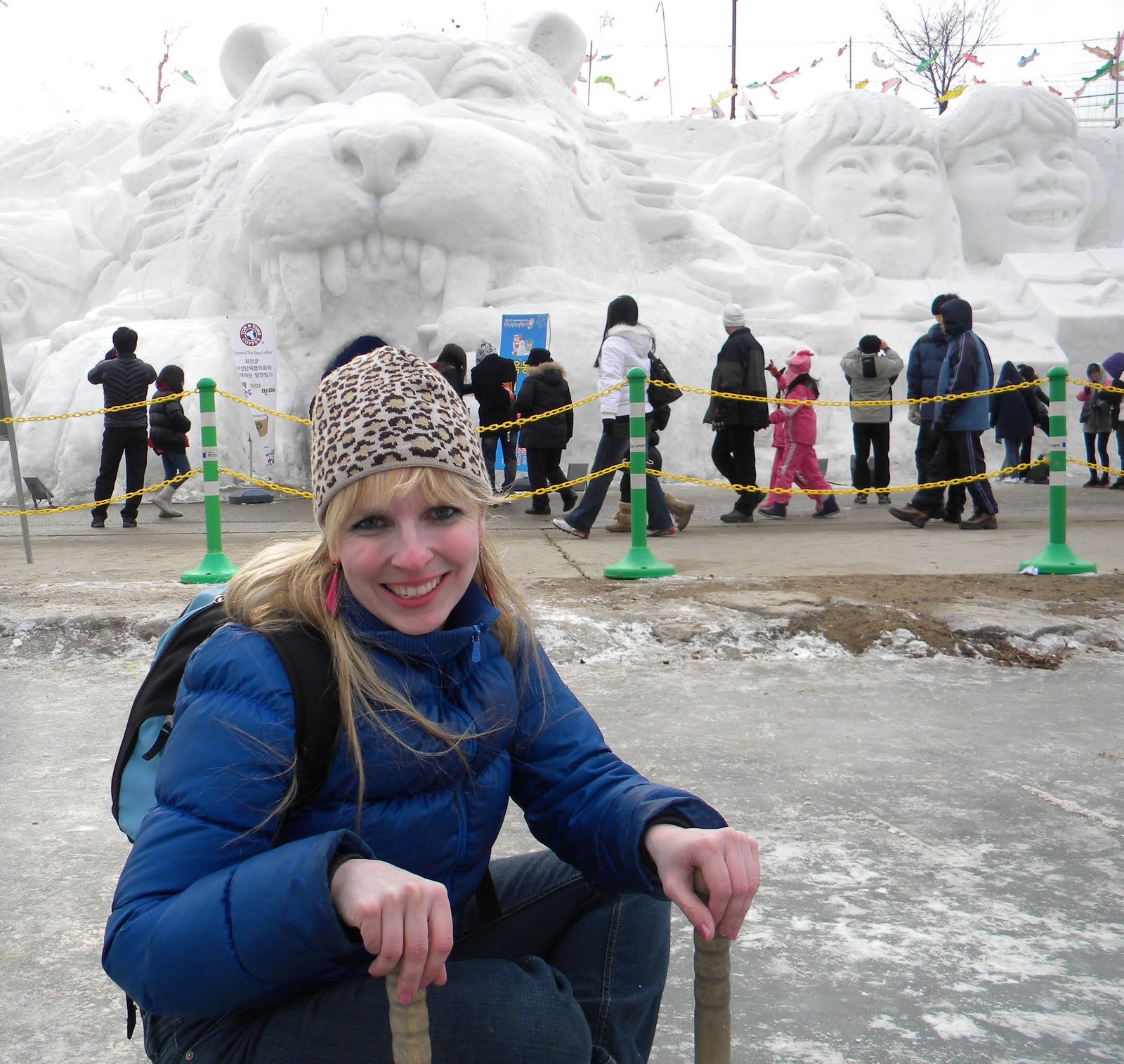
After finishing eating and drinking with Peter (we, at least, managed to contribute the drinks), we entered the gaping, fanged mouth of a white tiger. The tiger was, of course, made of snow. Inside the tiger's belly was a long tunnel and several small rooms made entirely of ice and backlit in blue and green lights so that it had the outlandish atmosphere of a night club, albeit the world's chilliest night club.


Following this, our group separated somewhat, scattering on the ice as we found the section of the river that had been portioned off for ice sledding. Several members of our group played on a large, multi-person sled. As for myself, I rented one of the tiny ice sleds. It was just a small, square wooden board with a set of blades on the bottom, such as you might find on ice skates. Following the example of countless children and adults around me, I sat crosslegged on my new vehicle and used the two icepicks I'd been given to dash into the ice and then propel myself forward.


From my vantage point of the ice sled, I discovered many things to see at the festival, including the results of a creative sled-building contest, which had resulted in sleds made to look like tigers, tomatoes, and sea gulls.


I also noticed a trail where children could rent teddy bear rickshaws. It entertained me greatly to see the little mechanical bears jerk their rickshaws up and down the road, often abruptly halting, their tiny feet impotently moving in place, as they found no traction on the iced trail.


In the evening, our small group reunited, perhaps called out by Jonathan, who somehow convinced the man in charge of the loudspeakers (which reached almost the entire festival) to let him perform a brief karaoke dedicated to English teachers. And then, just when we thought the trip couldn't get any better, we discovered human bowling.


Finally, it was time to go home, with an odd constellation of paper fish lighting our way.

Cat in the Hat That Looks Like a Cat

I push back my white kitten hood, which has slumped over my forehead, momentarily obscuring my short blonde bangs, tell-tale sign of a waygook, and emit a low hiss. Forever being crushed in the crowd of Seoulites, pushed and prodded by both people and their suitcase-sized bags, I have little means to protest my treatment, certainly not language, so in an ill-mannered intent to express discontent, I have adopted a cat’s hiss when the people around me are too rough.

My strange behavior began when I first arrived in Korea, months before acquiring the cat hat, following the suit of one of my beloved cats back home in America. She is a dainty little golden-red princess of a cat. Generally docile and amiable, her sweetness dissolves when something threatens her wellbeing – such as a vacuum cleaner or bubbles – and overcome by the threat, her mouth draws back into a feline grimace as she emits a prissy little hiss in protest. That has become me – also dainty, generally sweet tempered, but sometimes pushed too far by things that are beyond my comprehension, and probably that to the rest of Korea seem as harmless as soap bubbles or vacuum cleaners.

Crafted of white velour, and including the features of pointed ears and a red, heart-shaped nose, my kitten hat is something that only a child under the age of five would wear in the Western world; however, certain gender and age-appropriate rules that are inherent in Western society don’t seem to exist in Korea. While it’s true that small children here wear animal hats, this is a more common fashion item among the adults. On a fairly regular basis, I’ll watch a Korean man strolling down the street, with the cool swagger that only college guys in their 20s seem to possess, and also with a grinning polar bear perched atop his head, the fuzzy pink pom poms dangling loosely beneath his chin.

At times, the kitten hat provides me partial anonymity, especially if I comb back my bangs and tuck my blonde ponytail into the back of my coat. People need to actually look at my face to determine that I’m a foreigner, and since commuters don’t always watch the faces of those around them, I’m given a brief respite from the continual stares and my continual status as different. That’s the worst thing about being a foreigner – the thing that grates after months: I’m always treated as different. The majority of the time I’m treated with extra consideration, which is nice, but means a barrier of politeness has been erected between me and the other person. On other, somewhat rare occasions, I’m treated with rudeness. Never am I treated as just an ordinary person. As an artist and as someone who grew up in a small town where conformity was rigidly demanded, I’ve always quietly rebelled against being the same as everyone else. Now that I’m at a place where I so clearly stand out, I just want to blend in.


Perhaps in part because of this desire to belong, I, myself, have begun to adopt Korean viewpoints in some unexpected ways. Praise, a Korean American office mate, and I were recently riding to Sillim, a district in southern Seoul.

“Do you know,” said Praise, using a tone of voice that is generally reserved for conspiratorial gossip, “that Sillim is full of white people? I saw three white people just last night.”

“Really?” I responded with surprise and genuine concern at such a large number of whites overtaking a city of 10 million.

“Hey!” I said, as a second realization suddenly struck me, “I’m white. And you ran into me in Sillim yesterday.”

Tuesday, October 6, 2009

Surviving Jirisan


Because the letter “j” in Jirisan is pronounced with a decided “chuh” sound, this tallest mountain cluster in mainland Korea sounds like the word “cheery san.” A more likely misnomer never existed.

The first time I heard about the Jirisan mountains was after one of my co-workers, an avid hiker, returned from a trip with a severely injured knee. She could barely walk and hobbled about the office, only now and then referring to her trip, with a certain bitterness, as being the hardest hike in Korea.

"Oh, cheery-san, horrible cheery-san," she would moan as she limped through the university grounds.

I was interested in hiking, certainly not the dreadful cheery-san, but an easy, pretty little mountain would do. I received a FB message from someone I'd met at a party. His name was Warren, and he was a dedicated hiking leader. The message was an invitation to me and a number of other people, to trek though Jirisan. The problem was that as I read this word, I mentally pronounced it "jeer-esun."

In blissful ignorance of the actual destination, I replied to Warren's message by asking a few questions. What was the difficulty level of the hike? I was fit, but had not done mountain hiking since visiting Hawaii five years ago. Would this be a problem for me? Oh no, Warren quickly responded. It was an easy hike; even small children would be skipping along the trail.

Warren was an optimist.

And so was I.

I boarded the bus for Jirisan at 11:30 pm on a Friday night, as part of a group of about 40 hikers. The ride to the mountains took several hours and then, still sleepless, we began our hike before dawn. Our hiking group was comprised of all different nationalities, though mostly everyone was communicating with each other in English. Before leaving the bus, Warren, our group leader, suggested that we should all form mini-groups of five so that no one would get lost or left behind. This resolution was disbanded shortly after we started the trail and everyone immediately determined their own individual pace. While reasonably fit, I had not trekked a mountain in almost five years. The earliest section of the hike was easy, with a wide, smooth, clearly-marked path. Inspite of being tired, the autumn chill and excitement tempered my mood, so that my body felt alert and I climbed the first few hours with ease.


Going up the mountain was only a slight challenge. We set out in the pre-dawn, and as I had no torch, I kept my pace slow, but silvery threads of moonlight shone down through the trees and cast sufficient light, so that I managed to reach one of the lower summits before dawn and waited, with a cluster of other hikers, to see the sunrise. We could not see much in the way of bold colour change – Jirisan is infamously famous for holding back on its sunrise displays, but the subtle softening of the sky as it digressed from a rich black to mother-of-pearl grey to pale, almost-transparent blue was still lovely to witness. The lifting of darkness revealed clouds halo-ing the mountain tops below us, so that the mountain peaks appeared to be islands floating in a creamy, misty lake.


The path had pretty vistas, but continued to lead further and further up the mountains. It lead through forests with trees that still had the remnants of brilliant scarlet and gold leaves. There was a thin, silvery stripe of water running through the mountains and, at places, stone fountains built for easy access to the mountain springs. As I went along, the path grew more narrow and steeper. It was also treacherous considering the large number of rocks and boulders strewn in the path. I began to worry that, like my co-worker, I would also twist my leg as I shakingly set it down on the large, sharp rocks that decorated the latter part of the trail.

Midway through the hike, I came upon a clearing that had a cabin for those who chose to spend the night, and wooden benches and tables for those who were hungry. Also around this area, there were mounds or cairns, where rocks had been carefully piled by hikers passing through.


I fell further behind the group and only maintained any sort of momentum at all out of shame as the wizened little adjuma who appeared on the trail in front of me leant down and grabbed boulders in the path with both her hands and then leapt over them, like a determined gnome in a fairy tale.

After about 6 hours of climbing the mountains, my legs were starting to shake. I'd already begun the twisting descent of the trail and was feeling a drain to my energy. I was tired, never having slept the night before, and though I "exercised" nearly every night by dancing, different muscles in my legs were now being called to use, muscles that I'd never even noticed as a part of my body until they protested for me to stop torturing them and rest.

But at this point, I was alone, behind the others on the trail. I was slow, so much slower than the other hikers, a large number of whom hiked several times a month. So I stubbornly pushed my body forward.


The real challenge of the trek was not, as I had originally anticipated, going up the mountain. No, the hardest point was coming down the mountain. The path was strewn with a series of rough-edged, grey boulders, both large and small, and these were a constant threat for either stumbling and twisting an ankle or sliding off. The fact that I was not wearing athletic footwear did not help. I am not so dim as to not appreciate the value of athletic footwear; it was just that the brand new sneakers I had brought to Korea turned out to be a half-size too small. To compensate for this, I bought a daisy-patterned pair of Vans which were a half-size too big. On the positive side, they had been on sale for only 20,000won ($18). On the negative side, the soles’ level of traction was equivalent to satin, which meant I could potentially slip and fall to my death. But since I’m more of a glass-half-full kind of girl, I decided to concentrate on the daisy pattern and not falling. My optimism, however, failed to quench the physical pain that ensued during the last hour of climbing down the mountain. Every step down resulted in a shock of pain in my knees. It felt as though invisible men were pounding them with mallets, without any intention of stopping before each knee had turned into a quivering mass of jelly. I did not complain, nor did the people around me complain, but I noticed that several hikers’ legs were shaking and did not stop shaking until we’d ended the hike.

Finally, around mid-day, I stumbled out of the forest, to the small town at the end of the mountain. This was where our bus had driven and was waiting to take us to the nearby city of Namwon, the city of love.

Ending the hike a rough 12 km from where we’d begun, our group ended in a small town on the other side of the mountain. The group seemed smaller than before, but I couldn't be sure. I had been so tired on the bus ride over and had been sitting at the front of the bus. Perhaps it had not been full on the ride over. It certainly was not full now, as we wearily trooped onto it for the drive to Namwon. In Namwon, we’d been promised festivals, romantic legends, a musical performance, and a type of porridge special to that region of Seoul.

“Well,” said Warren, looking around at our group, “we may have left a few people back on the mountain.”

We waited a while for the dilatory hikers to show, but the rest of our day had been divided into a fairly strict schedule. There was music to hear, drums to beat, porridge to eat! As much sympathy I felt for those few people left on the mountain, my biggest motivation in joining this tip was not in scaling the mountain, but coming down the other side so that I could do the fun cultural activities as promised. Namwon was the proverbial carrot on the stick for me. I then felt happy, with only the smallest possible twinge of guilt, when Warren decided the group would continue on to Namwon and he would stay in contact with the other hikers via cell phone.

In Namwon, we gathered for a much-needed dinner. There were dozens of different food items laid out on the long tables, as we sat crossed legged on the floor in front of them. There was a reddish-orange porridge that was special to the area and a type of fish that was decidedly pungent and delicious, in addition to the dozens of items I could not name but that probably contained some form of seaweed, tofu, rice, or a combination of the three.


After dinner, we were given about 30 minutes to explore the town. Quite frankly, this was done at my demand. We had been told beforehand that we were going to spend several hours in Namwon, but after dinner, Warren attempted to hustle us on the bus, saying that we'd taken too much time in trekking. No, I insisted, half entreatingly, half demandingly. I'd dragged myself hours up and down the mountains in anticipation of arriving at this famous city. I would not leave until I'd at least walked around a bit. Warren kindly relented and I walked through the city with the contentedness of a cat before cream.

The legend about the lovers of Namwon is really quite famous throughout the country -- I've even listened to a Korea opera sung about it -- and I was excited to see its romantic origin, remotely similar to Romeo and Juliet, but with a happier ending.


As I stood looking down the street, I noticed a long black car slowly approaching. It had a floral wreath tied to the hood and drove at such a slow, somber pace that I lowered my head, believing it to be a funeral car. Imagine my surprise, then, when I looked at the trunk and saw a doll-like young bride dressed in a long, red Hanbok and sitting among piles of brightly coloured flowers. There were red and yellow and pink ribbons wound about her hands. Following the car was a young man, his wrists bound by the other end of these same ribbons, motivating him to trot along behind the car at a steady pace.

(different honeymoon car in Namwon)

After we’d spent a while in Namwon proper, having seen the sights and having eaten our pumpkin porridge, we boarded the bus once again and drove to the music and culture center, which was located on the outskirts of Namwon. Trimmed into the ground shrubbery behind this huge building was a series of silhouettes of a man with a guitar-like instrument. We were late in entering the building, so the attendants of the music center quickly rushed us into an upstairs room that had a large, empty wooden floor and a slightly elevated stage filled with instruments. In spite of our tardiness, we were given a complete, if abbreviated, performance for several traditional forms of Korean music. A woman – someone from the group translated for us – requested that we politely clap after all the performances. Another woman then shyly entered the stage and sat behind an instrument that had the appearance of a keyboard but the resonance of a harp. First, she played a traditional Korean melody. We all listened quietly and then politely clapped. And then, in case we were homesick for standard American tunes, she played the Beatle’s “Let It Be” and “Somewhere Over the Rainbow.” The latter is a favorite of mine and I clapped with more enthusiasm than was polite after she’d finished her performance.

Next, two other women, beautifully attired in pastel hanbok, came to the stage. One of the women kneeled in front of a large pansori (drum) at stage left and the other woman took center stage.


Perhaps feeling that the crowd was not participating enough, one of the Korean singers then led us in a sing along, which can generously be dubbed "an interesting performance" considering that most of us had trouble saying "bibimbap" in Korean, much less doing a listen and repeat of the turbulently high-pitched lines in traditional Korean opera. One of the few girls who possessed dual proficiency in English and Korean later explained the meaning of the song to us. Apparently, we’d been attempting to sing a song that was not just romantic but rather risqué: please come to my bedroom, please climb on my back, please be my monkey of love we’d sung with quavering seriousness. That’s traditional Korea for you. At least they used "please."

The ride back from Namwon to Seoul was uneventful, except for the fact that at this time Warrent revealed the stats to the hikers who remained. Out of the 40 people who started the hike, 18 had been left on the mountain. All the time I had believed I was one of the slowest hikers was not exactly true. I was merely one of the slowest out of the fast group. What's slightly more alarming is that out of the 18 left on the mountain, only 16 eventually made it back by themselves. Two of the hikers had to be airlifted off the mountain, due to exhaustion and the intense muscular pain of the hike.


(The lovers of Namwon: TLA or just another hiker being carried off the mountain?)